
GERMAN PHILATELY
PROPAGANDA POSTCARDS
(1933)
This page was last updated
16-Sep-2026 05:26
18. DEUTSCHES BUNDESKEGELN
18th GERMAN BOWLING COMPETITION
(15th/23rd Jul 1933)
The 18th German Bowling (Skittles) Competition was held from 15th to 23rd Jul 1933 in the city of Frankfurt. The image depicts a bowler aiming at a set of 9 pins with the 'DKB' (Deutsche Bundes Kegeln) logo. The building on the lower right of the image is the Emperor’s Cathedral of St. Bartholomew (a.k.a Frankfurt Cathedral) or 'Kaiserdom Sankt Bartholomäus'.
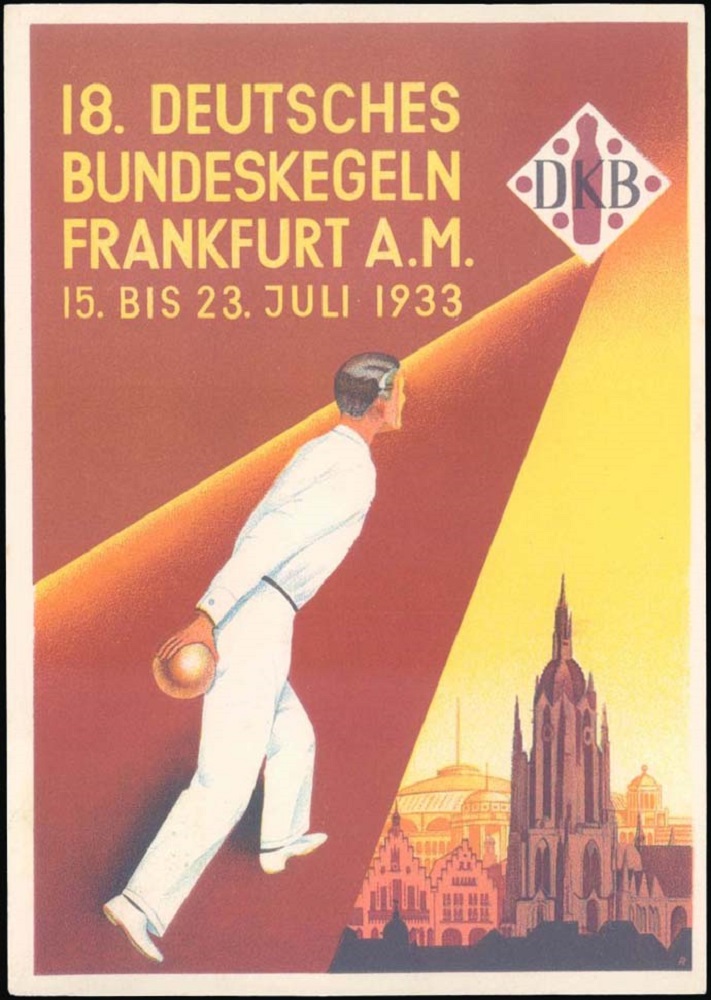
In complete contrast to the political and party material so far reviewed in 1933, this card advertises the "18. Deutsches Bundeskegeln", (18th German National Bowling/Skittles Championship) held in Frankfurt am Main, from 15th to 23rd Jul 1933, it carries no overt party symbolism.
Front: A dynamic Art Deco-style illustration of a bowler in white sporting attire, captured mid-motion as he releases the ball, dramatically lit against a red-to-gold gradient sky. In the lower right, Frankfurt's skyline is recognizable, most notably the distinctive spire of the Kaiserdom (Frankfurt Cathedral) alongside other historic civic buildings.
In the top right corner is the diamond-shaped emblem of the "DKB", the Deutscher Kegler-Bund, (German Bowlers'/Skittles Federation), the sport's national governing body, marked with a stylized skittle pin. "Kegeln" is the traditional German form of ninepin bowling, and a "Bundeskegeln" was the federation's national championship tournament, the "18th" edition here implies a tradition already going back decades before the Nazi era.
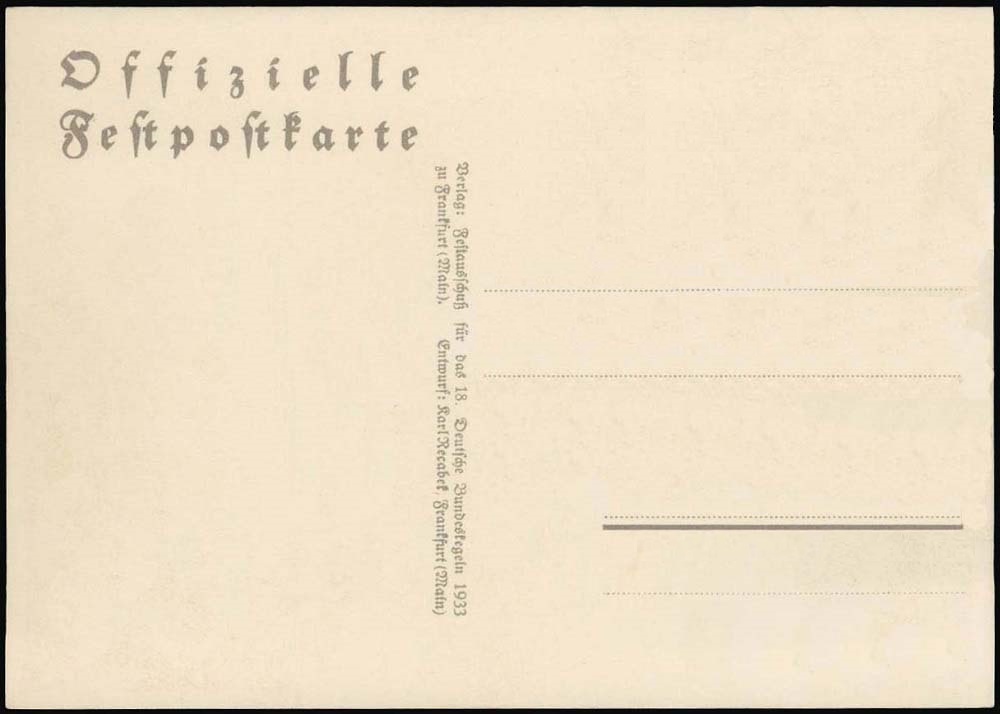
Back: Labeled "Offizielle Festpostkarte" ("Official Festival Postcard"), published by the "Festausschuß für das 18. Deutsche Bundeskegeln 1933 zu Frankfurt (Main)" (the event's own organizing festival committee), designed by "Karl Reeder, Frankfurt (Main)."
This fits the pattern of an established German sporting or civic federation carrying on its normal, long-running national event schedule in 1933 with entirely conventional, apolitical promotional material, a useful reminder that alongside the rapid political upheaval, ordinary institutional and sporting life in Germany often continued to present itself in familiar, unpoliticized terms, at least in its public-facing advertising, even as those same organizations would in many cases be absorbed into Nazi-aligned sport federations (like the NSRL, the National Socialist Reich League for Physical Exercise) within the following year or two.
