
GERMAN PHILATELY
PROPAGANDA POSTCARDS
(1933)
This page was last updated
16-Sep-2026 05:27
WHITSUN HOLIDAY
(Jun 1933)
BACKGROUND: This postcard commemorates the Whitsun Holiday collection for the VDA (Volksbund fur Deutschtum in Ausland) in June 1933
SONDERSTEMPEL:
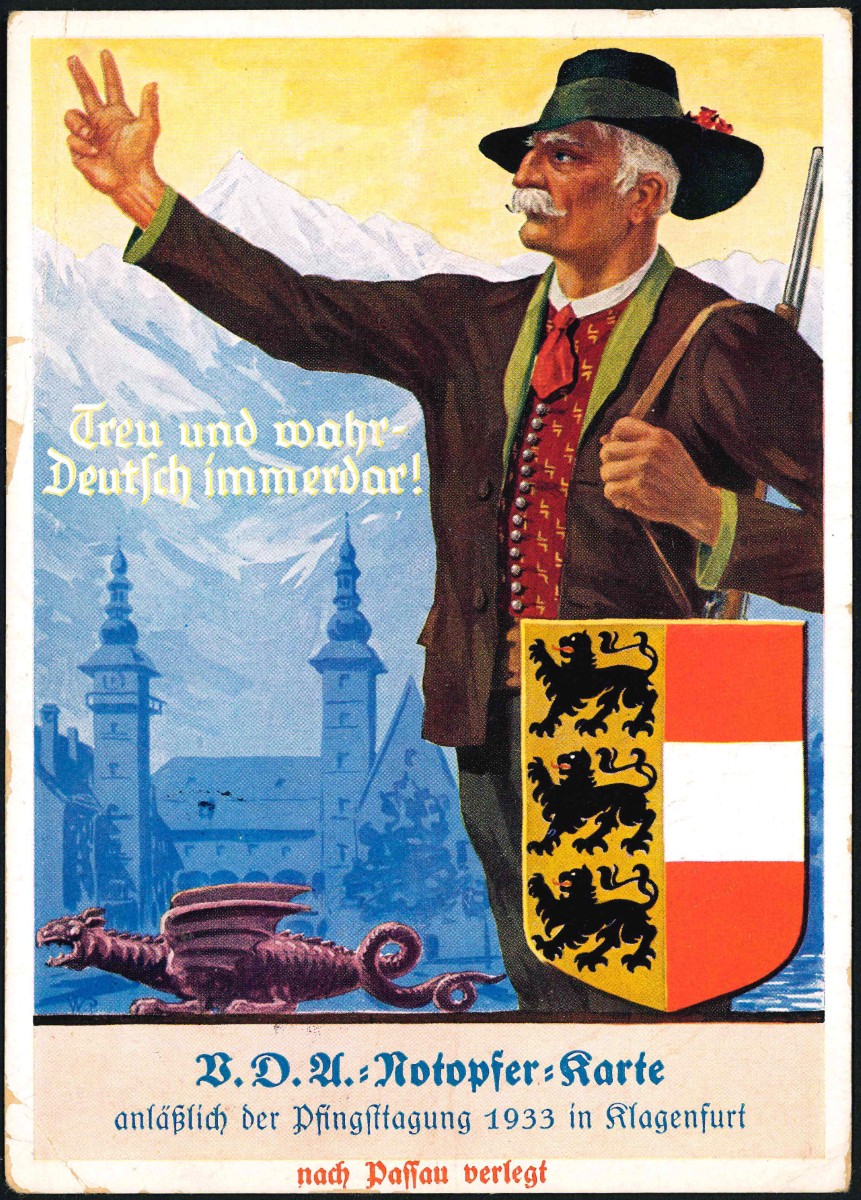
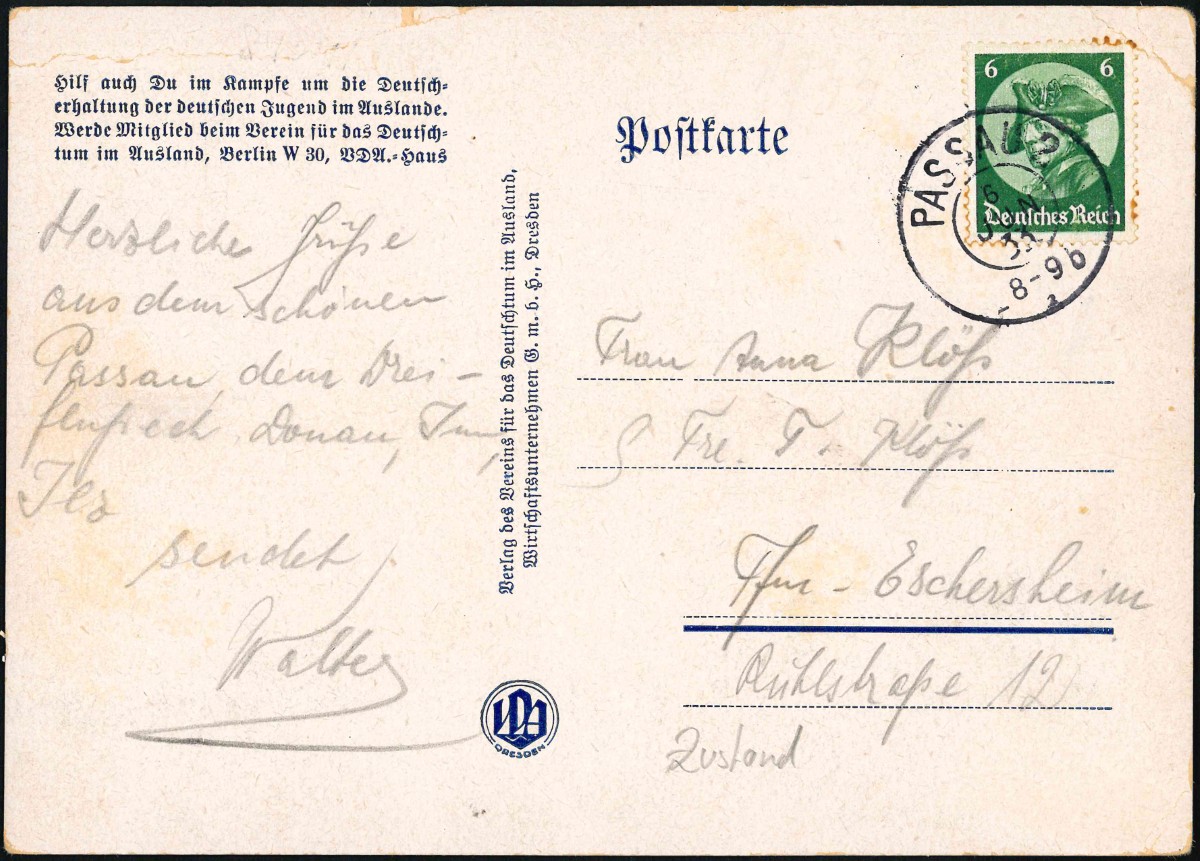

Front: V.D.A.-Notopfer-Karte, Pentecost 1933
The V.D.A. was the Volksbund für das Deutschtum im Ausland, founded 1881 as a schools association, renamed Verein für das Deutschtum im Ausland in 1908 and Volksbund in 1933, when it was brought into line with the new regime. It funded German-language schools and cultural work among German minorities beyond the Reich's borders. "Notopfer" cards were fundraising items: sold at a premium at rallies and conferences, the surplus going to that work.
The imagery is entirely Carinthian. The man wears Carinthian Tracht with a slung rifle and raises the traditional three-finger oath hand, a direct evocation of the Kärntner Abwehrkampf of 1918-19 against Yugoslav troops and the plebiscite of 10th Oct 1920 that kept southern Carinthia with Austria. Behind him are Klagenfurt's two landmarks: the Lindwurm dragon fountain on the Neuer Platz and the twin towers of the Landhaus. The shields are Carinthia (three black lions on gold) and Austria (red-white-red). The slogan "Treu und wahr | Deutsch immerdar!" is standard Carinthian Deutschtum rhetoric of the period.
The interesting line is the red overprint at the bottom: nach Passau verlegt, "relocated to Passau." The Pentecost conference was planned for Klagenfurt (Pentecost fell on 4th Jun 1933) and then had to be moved across the border to Passau in Lower Bavaria, a few kilometres from Austria. Spring 1933 is exactly when relations between Hitler's Germany and Dollfuss's Austria collapsed: Berlin announced the Tausend-Mark-Sperre on 27/29 May 1933, effectively pricing German travel to Austria out of reach, and Vienna was clamping down on pan-German and Nazi gatherings (the NSDAP was banned outright in Austria on 19th Jun 1933). A large German nationalist congress on Austrian soil became impossible, and the printed card was overprinted rather than scrapped. That overprint is what makes the card collectible, it's a small artifact of the diplomatic rupture.
