
GERMAN PHILATELY
PROPAGANDA POSTCARDS
(1934)
This page was last updated
16-Sep-2026 05:27
BORSTORF-FEIER 1634 - 1934
300th ANNIVERSARY of BORSTORF
(26th May / 3rd Jun 1934)
Issued to commemorate the 300th Anniversary of Borsdorf in the district of Lauenburg in Schleswig-Holstein. The card is inscribed 'BORSDORF-FEIER | 1634 1934 | Bad Liebenwerda 26.Mai und 3.Juni'
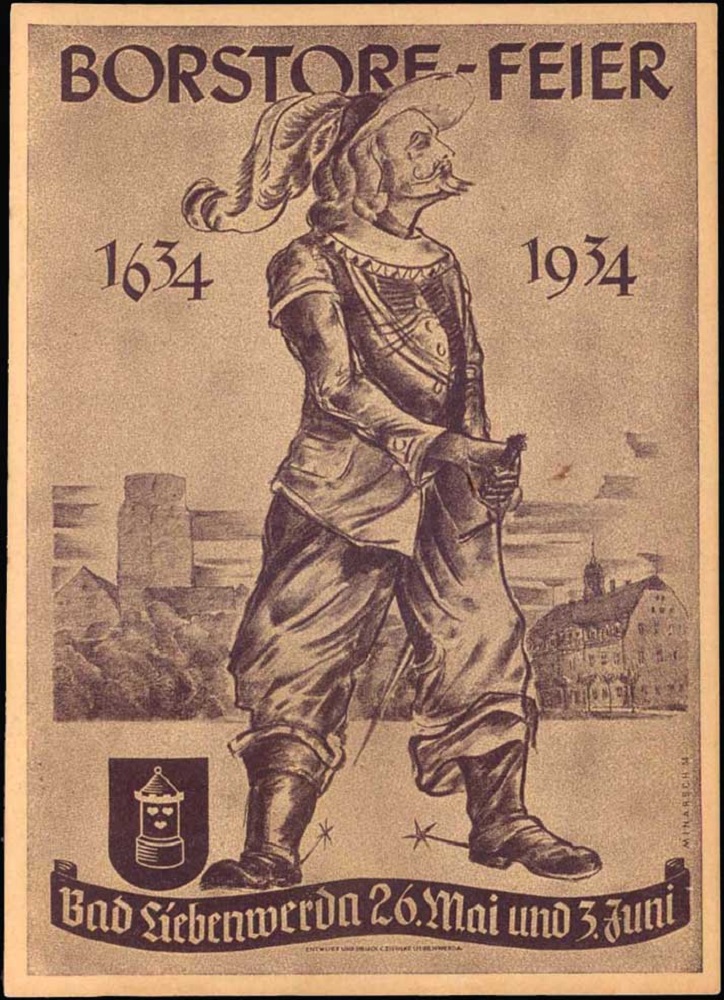
This card is a local historical/heritage commemoration rather than explicit party political propaganda, though it still reflects broader currents in 1934 German nationalism.
Front: Titled "Borstorf-Feier" ("Borstorf Festival/Celebration"), flanked by the dates 1634 and 1934, marking a 300th anniversary (tercentenary). The illustration shows a man in 17th-century burgher dress: plumed hat, ruff collar, doublet, and wide "pumpkin" breeches typical of the Thirty Years' War era (1618–1648), walking purposefully with a sword. In the background are a castle/tower ruin and a townscape. A shield in the lower left bears the local coat of arms (a tower motif). The bottom banner gives the event location and dates: "Bad Liebenwerda, 26. Mai und 3. Juni" (May 26 and June 3). Bad Liebenwerda is a small spa town in Brandenburg/Saxony.
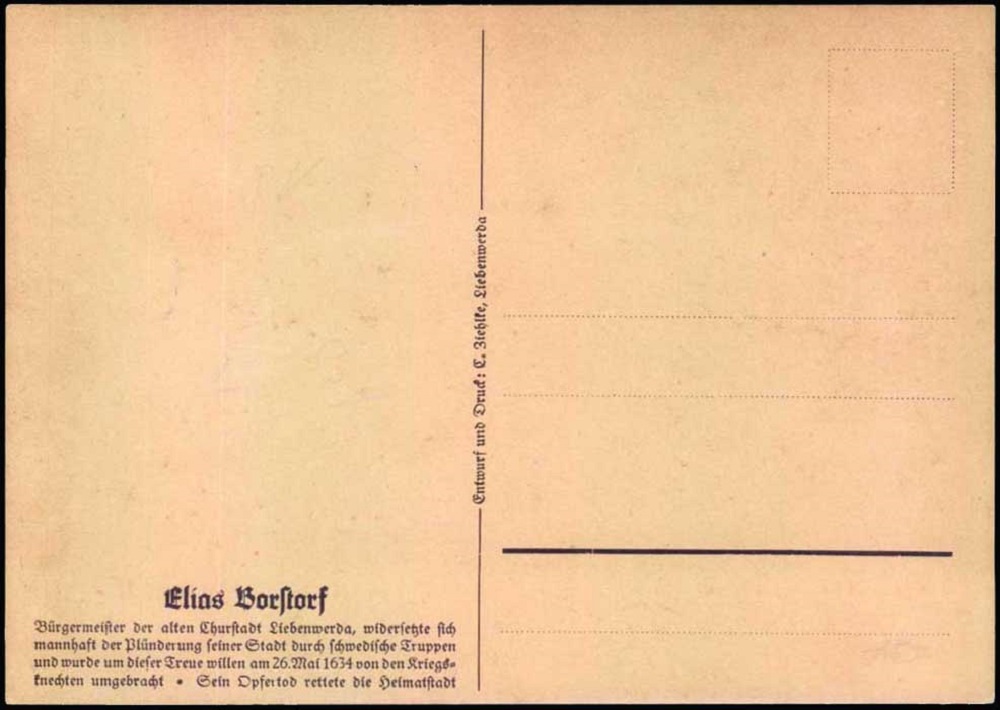
Back: Explains the history behind the festival. The text (partly cut off) reads:
"Elias Borstorf, Bürgermeister der alten Churstadt Liebenwerda, widersetzte sich mannhaft der Plünderung seiner Stadt durch schwedische Truppen und wurde um dieser Treue willen am 26. Mai 1634 von den Kriegsknechten umgebracht. Sein Opfertod rettete die Heimatstadt..."
"Elias Borstorf, mayor of the old electoral town of Liebenwerda, bravely resisted the plundering of his town by Swedish troops, and for this loyalty was killed by the soldiers on 26th May 1634. His sacrificial death saved his hometown"
This places the event during the Swedish phase of the Thirty Years' War, when Swedish forces campaigned through Saxony/Brandenburg. The card was designed and printed locally by "C. Ziehlke, Liebenwerda," as noted on the back, for a town festival marking the 300-year anniversary of Borstorf's death, likely featuring a pageant or historical reenactment (hence the costumed figure) held over the two dates in May/June 1934.
The theme of a local burgher who sacrificed himself to save the "Heimatstadt" (hometown) from foreign plunderers fits neatly into the broader Nazi-era cultural emphasis on Heimat, local heroism, and self-sacrifice for the community, which regional heritage societies and town governments across Germany were encouraged to celebrate during this period, even when the content itself predates the Third Reich by three centuries.
