GERMAN PHILATELY
PROPAGANDA POSTCARDS
(1934)
This page was last updated
16-Sep-2026 05:27
18. BAYERISCHES LANDESTURNFEST
18th BAVARIAN GYMNASTICS TRIALS
(20th/22nd Jul 1934)
BACKGROUND: This card was published by Zerreiss & Co. of Nürnberg to commemorate the 18th Bavarian Gymnastics Trials (20th to 22nd Jul 1934) as well as the National Competition held from 23rd to 29th Jul 1934. The card was designed by artist H. Kannegiesser and the events were held in Nürnberg. THere were two versions of this card, the first in colour and the second in black and white.
SPECIAL CANCEL: There was no special cancel available as far as I am aware.
COLOUR VERSION
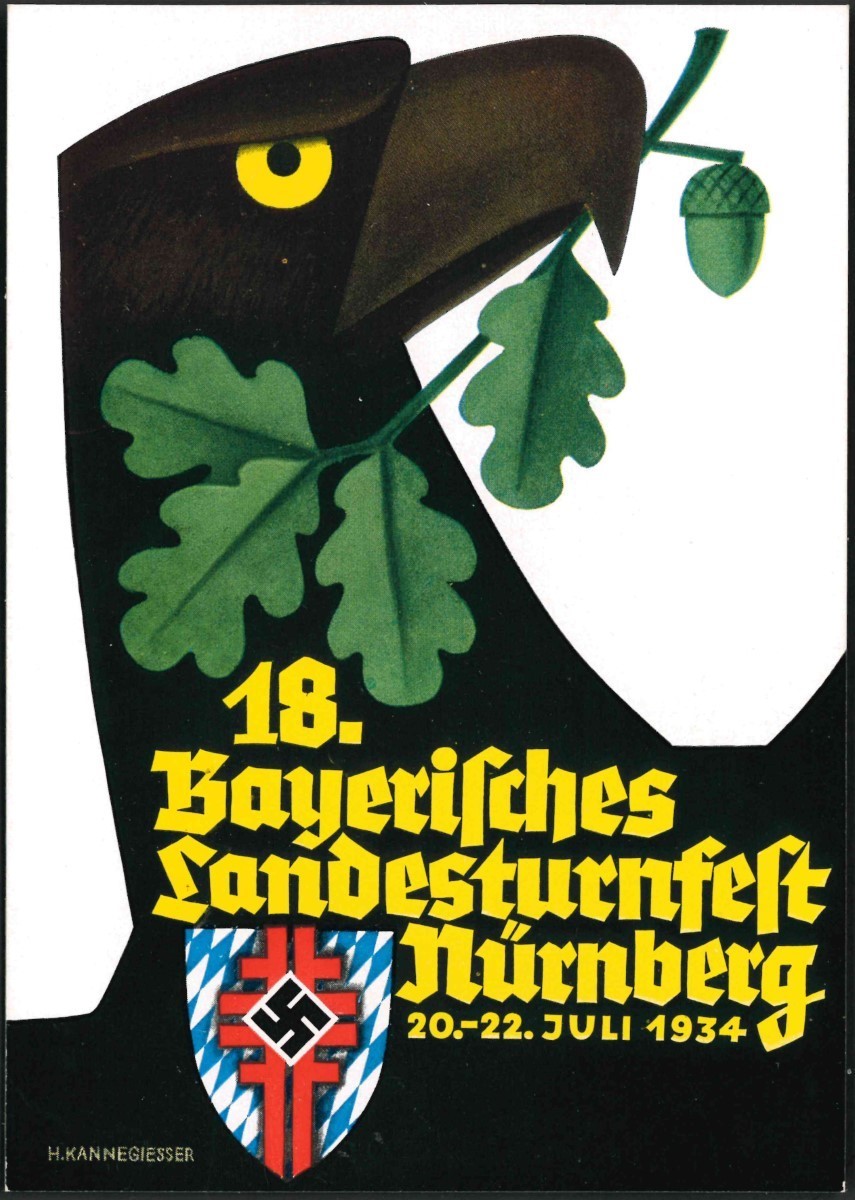
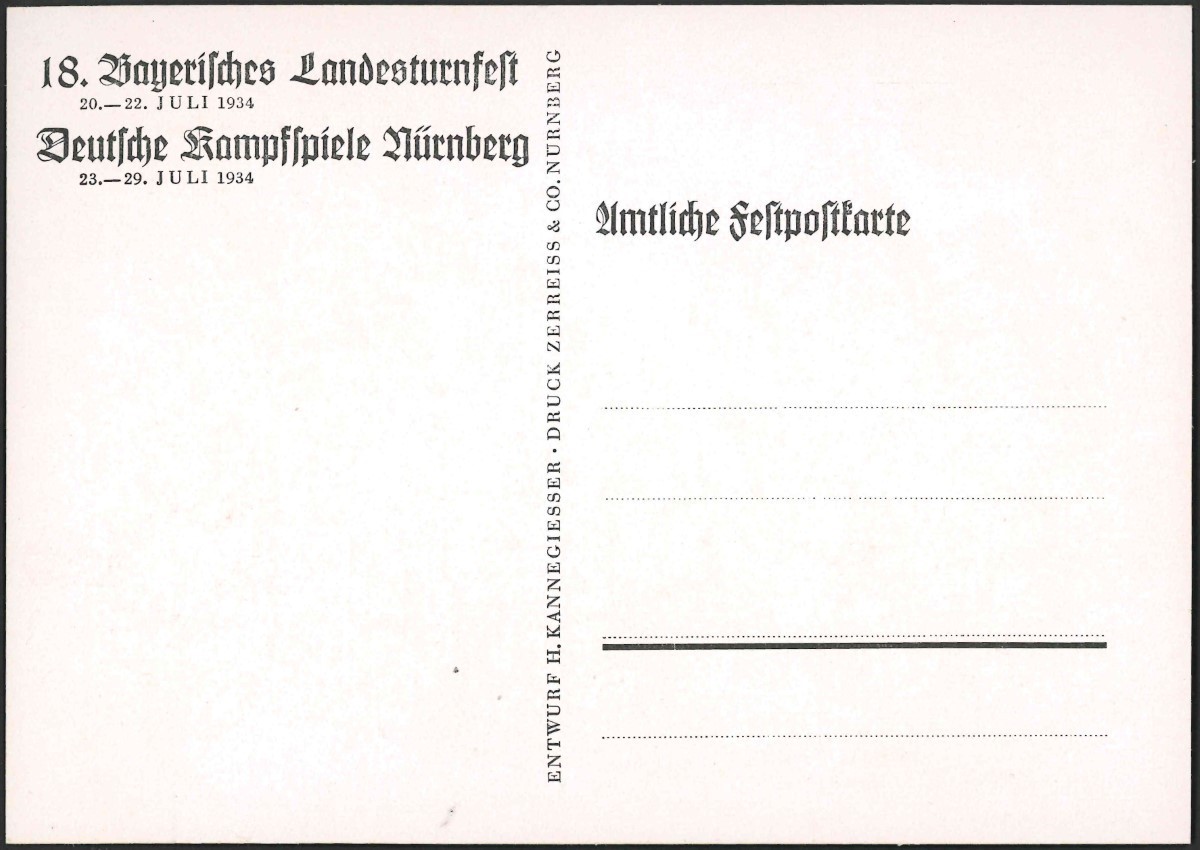

This is an official festival postcard for a gymnastics/sport festival in Nuremberg, and this quiet explicit in fusing traditional German symbolism with Nazi iconography.
Front: A bold, modernist design showing a stylized black eagle's head in profile with a striking yellow eye, holding an oak branch with leaves and an acorn in its beak. Oak leaves and acorns are a long-standing German national symbol (strength, endurance, the "German oak"), and the eagle likewise predates the Nazi era as a heraldic device, but here it's paired explicitly with a shield at the bottom showing the Bavarian white-and-blue diamond pattern (the traditional Wittelsbach/Bavarian rautenmuster) overlaid with a red cross bearing a black swastika, a deliberate fusion of regional Bavarian identity with the Nazi party symbol. Yellow blackletter text reads "18. Bayerisches Landesturnfest, Nürnberg, 20.–22. Juli 1934", ("18th Bavarian State Gymnastics Festival, Nuremberg, 20–22 July 1934"). The artist is credited as "H. Kannegiesser," also named on the back as the designer.
The "Landesturnfeste" were a long tradition in German gymnastics culture going back to the 19th-century "Turnverein" (gymnastics club) movement founded by Friedrich Ludwig Jahn, itself historically tied to early German nationalism. By 1934, though, these traditional sporting festivals were being absorbed into the Nazi sport apparatus (the German gymnastics/sport associations were "coordinated", gleichgeschaltet, under Nazi control in 1933), which is reflected in the swastika now appearing directly in the event's own emblem/shield.
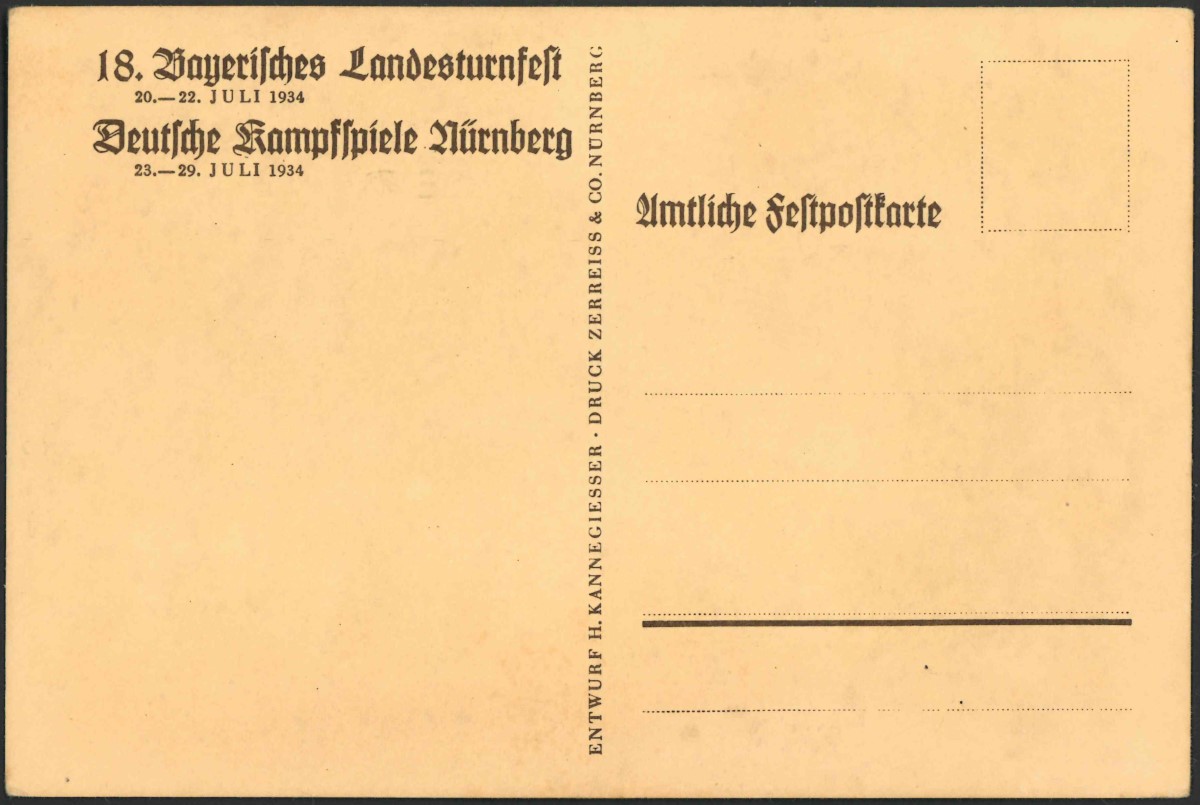
Back: Marked "Amtliche Festpostkarte" ("Official Festival Postcard"), listing two consecutive events in Nuremberg that summer: the 18. Bayerisches Landesturnfest (20–22 July) and, immediately following, the "Deutsche Kampfspiele Nürnberg" (German Combat/Competition Games, 23–29 July), a Nazi-era substitute national sports competition (Germany was barred from the 1920s Olympics arrangements’ international events context aside, and by the mid-1930s the regime was also building up Nuremberg as a symbolic host city ahead of the 1936 Berlin Olympics). Printed by "Zerreiss & Co., Nürnberg.".
Notably, Nuremberg itself was already emerging in 1934 as the Nazi party's premier symbolic city (host of the party rallies, Reichsparteitage), so hosting both a traditional Bavarian gymnastics festival and a new "German Combat Games" there in the same week reflects the regime's broader strategy of layering its own institutions and imagery onto pre-existing German civic and sporting traditions.
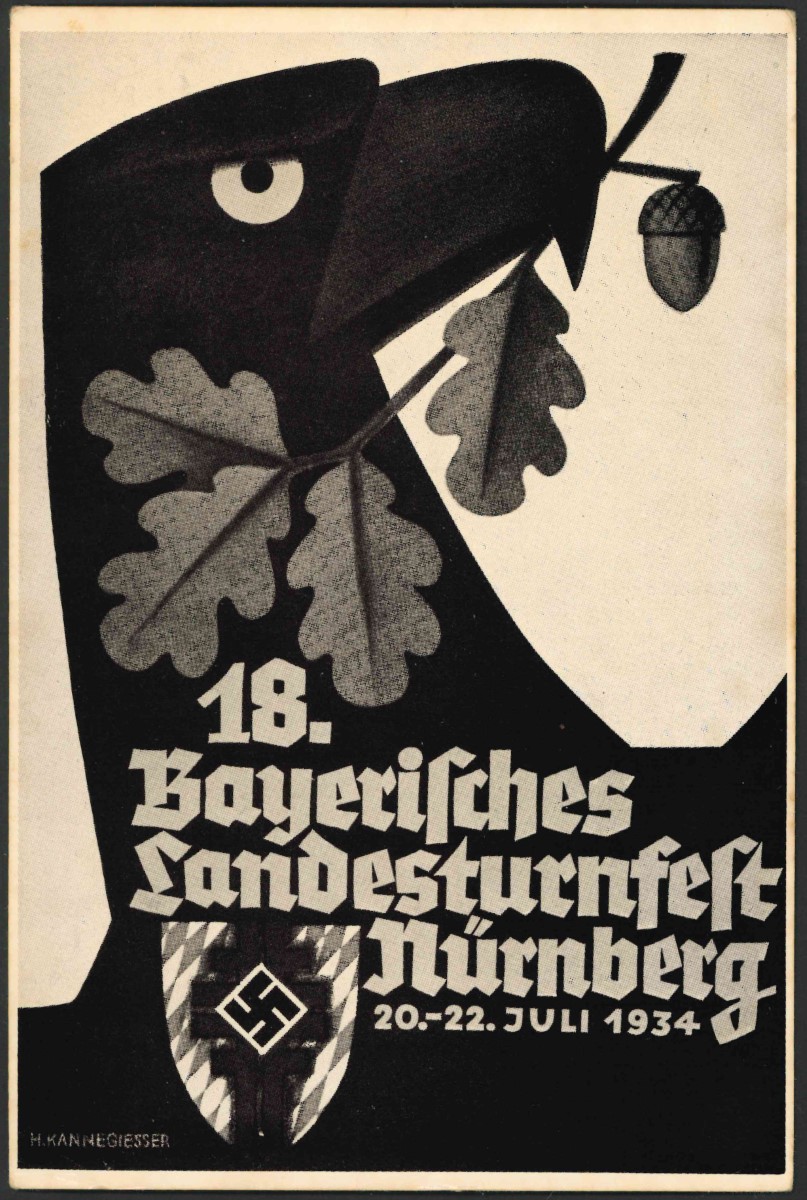
BLACK & WHITE VERSION