
GERMAN PHILATELY
SECOND WORLD WAR POSTCARDS
BARLOG BOOK
This page was last updated
05-Sep-2026 03:39

BARLOG BOOK / DRIESEN VERLAG
The cards are based on cartoons published in a book titled "Soldatenleben | Barlogs Aufklärungen für jeden Wehrpflichtigen" - 'Soldier's Life | Barlog's Information for Every Conscript', published c1937 and retailing for 1 RM. The book is a satirical look at a "typical day" in the life of a new recruit.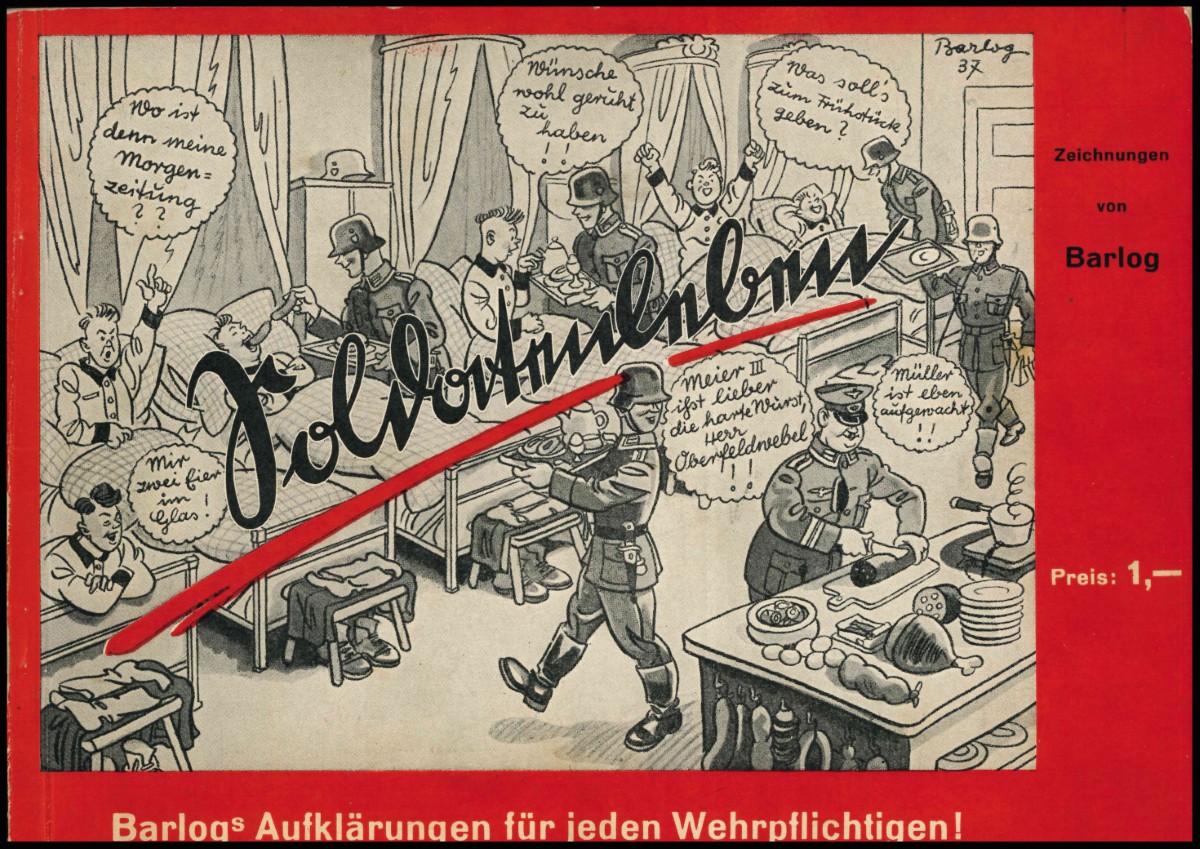

PAGE 1
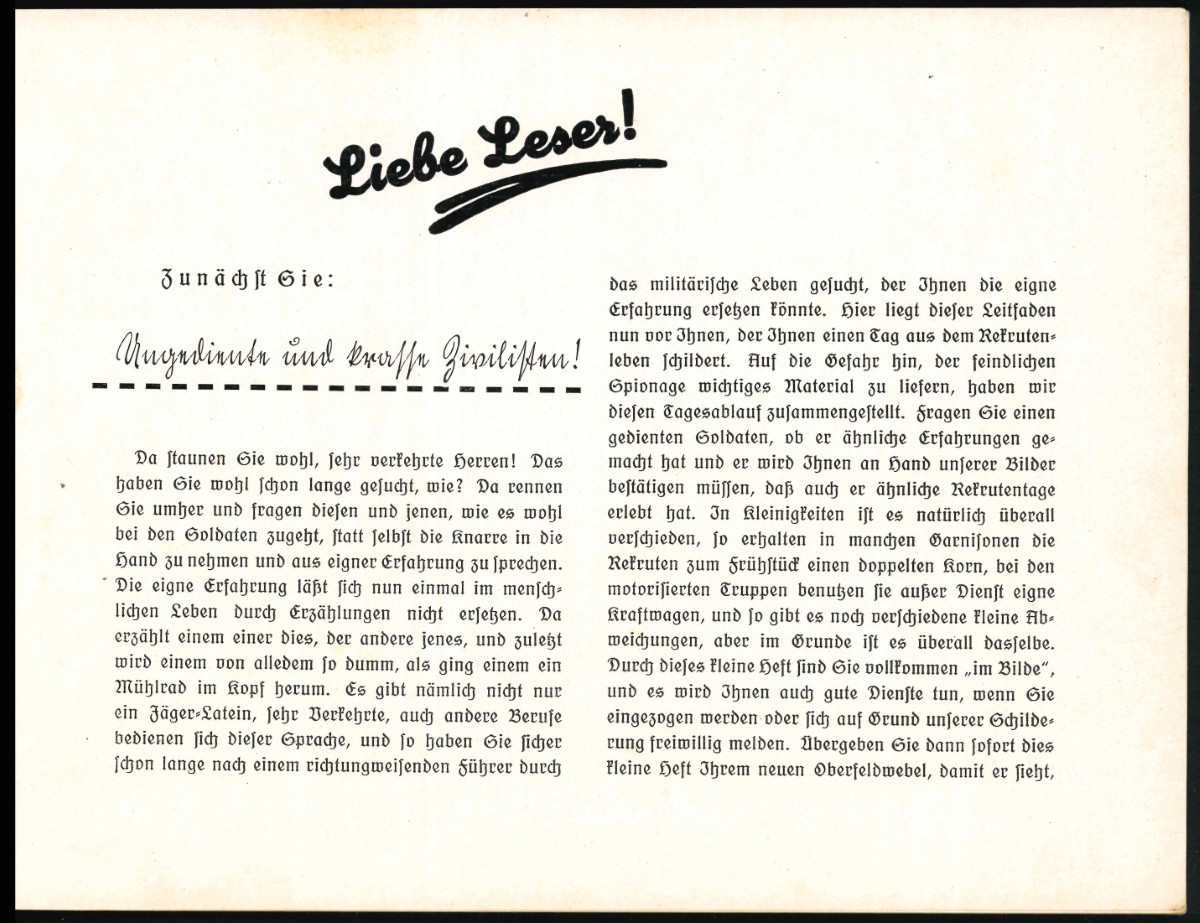

Non-veterans and utter civilians!
You're probably amazed, most esteemed gentlemen! You've probably been looking for this for a long time, haven't you? You run around asking this person and that person what it's really like among the soldiers, instead of picking up the rifle yourself and speaking from your own experience. In human life, personal experience simply cannot be replaced by other people's stories. One person tells you this, another tells you that, and in the end all of it makes you so muddled it's as if a millwheel were turning in your head. After all, it isn't only hunters who have their own "tall tales" — other professions use this kind of talk too, esteemed readers — so you have surely long been searching for a guide to point the way through military life, one that could substitute for actual experience.
Here, now, this guide lies before you, describing a day out of a recruit's life. At the risk of supplying valuable material to enemy espionage, we have put together this daily schedule. Ask any soldier who has served whether he has had similar experiences, and using our pictures he will have to confirm that he too went through similar days as a recruit. Naturally, in small details things differ from place to place — in some garrisons recruits get a double schnapps with breakfast, motorized troops use their own vehicles off duty, and there are various other minor variations — but fundamentally it's the same everywhere.
Through this little booklet you will be completely "in the picture," and it will also serve you well if you are drafted or volunteer based on our description. Then hand this little booklet over immediately to your new senior sergeant, so that he can see...
PAGE 2
...that you are informed about military life and that he can't put anything past you. Please let us know what your senior sergeant said, so that we can share in your joy. But make sure you hand the sergeant the booklet as privately as possible, so that his outbursts of delight don't draw unnecessary attention from others. And now go forth and do likewise!
Old soldiers, lend an ear!
Our greetings to you first,
You old warriors, sharpshooters and plinkers in war and peace! What do you make of our pictures, old comrades and army veterans? We can already hear you calling out: "One could practically jump out of one's trousers seeing how exactly everything is captured in these pictures... the way it was."
Yes, lads, you're amazed, aren't you! Over time a good many things had slipped our minds too, but once you really kneel back down into memory, one thing after another comes back to you, until finally: behold — with all its old freshness the old tailcoat comes rushing back and our army days stand before us again, alive and kicking. Wipe the tears of emotion from your beard — though it's gone by now anyway, dearly beloved! Yes, yes, August, where has your hair gone? "No one wore his curls like you did, no one wore his socks like you did." We simply have to move along with time, friends, otherwise time will move on without us, leaving no dry eye behind. And so, in that spirit, let's now turn to these pictures from the past.
Why let yourselves be pestered at the regulars' table with questions about your soldiering days, having to dig laboriously through your memories? Here — just lay this booklet on the table and say: "That's exactly how it was in our day too." And should some civilian in the group try to object: "But the other day you told it differently" — then cut him off and say: "You must have misunderstood me. Over such a long time, details sometimes slip one's mind. But now, seeing the pictures laid out before me, it all comes back to me, and I can only say: yes indeed, that's how it is and that's how it was, and whoever doesn't...
PAGE 3
...has done so pays a lap of honor, quietly and shamefacedly, in tribute to the old warrior." Thereupon you take a double schnapps, lads, and sing in a rough but heartfelt voice a verse about our Annemarie: "My child is named Waldemar, because it happened in the woods [Wald]."
We old bones won't let anyone take our humor away from us. "He who cannot make fun of himself is certainly not among the best," says Goethe, and the doughty champion of the faith, Luther, held that "If the good Lord had no sense of humor, I wouldn't want to be in Heaven." So soldiers, too, should be allowed their fun, and one shouldn't weigh every word on a jeweler's scale out of prudish stuffiness. We will certainly have made inquiries beforehand with the truly relevant authorities. That's something to write in the copybook of those sourpusses who believe they must add their two cents to everything and draw attention yet again to something that is already openly on display everywhere and has already received its approval. This booklet is meant for people who understand a joke, and whoever cries gets his money back. And if someone still grumbles, then we'll just reach back with the old vigor and freshness and give him... ten extra pfennigs. But then that's the end of it, and with that we now turn to you,
Young men on active duty!
Come a little closer, young comrades — first we'd like to have a few words with you, just among ourselves. You can see the humor in these pages, since you now belong yourselves to the initiated, to those who have served, and so we don't need to explain anything to you about these sketches, which are also meant for civilian eyes. But precisely for that reason we'd like to say a few serious words up front: look here, lads, it wasn't so very long ago that young people your age stood around on street corners without support, without backbone, unemployed and without hope, caps pulled down over their foreheads. What feelings an old soldier must have had, passing groups like that! And now we see you marching through the streets in upright bearing and brisk step, singing! Perhaps you don't fully understand this change, young...
PAGE 4
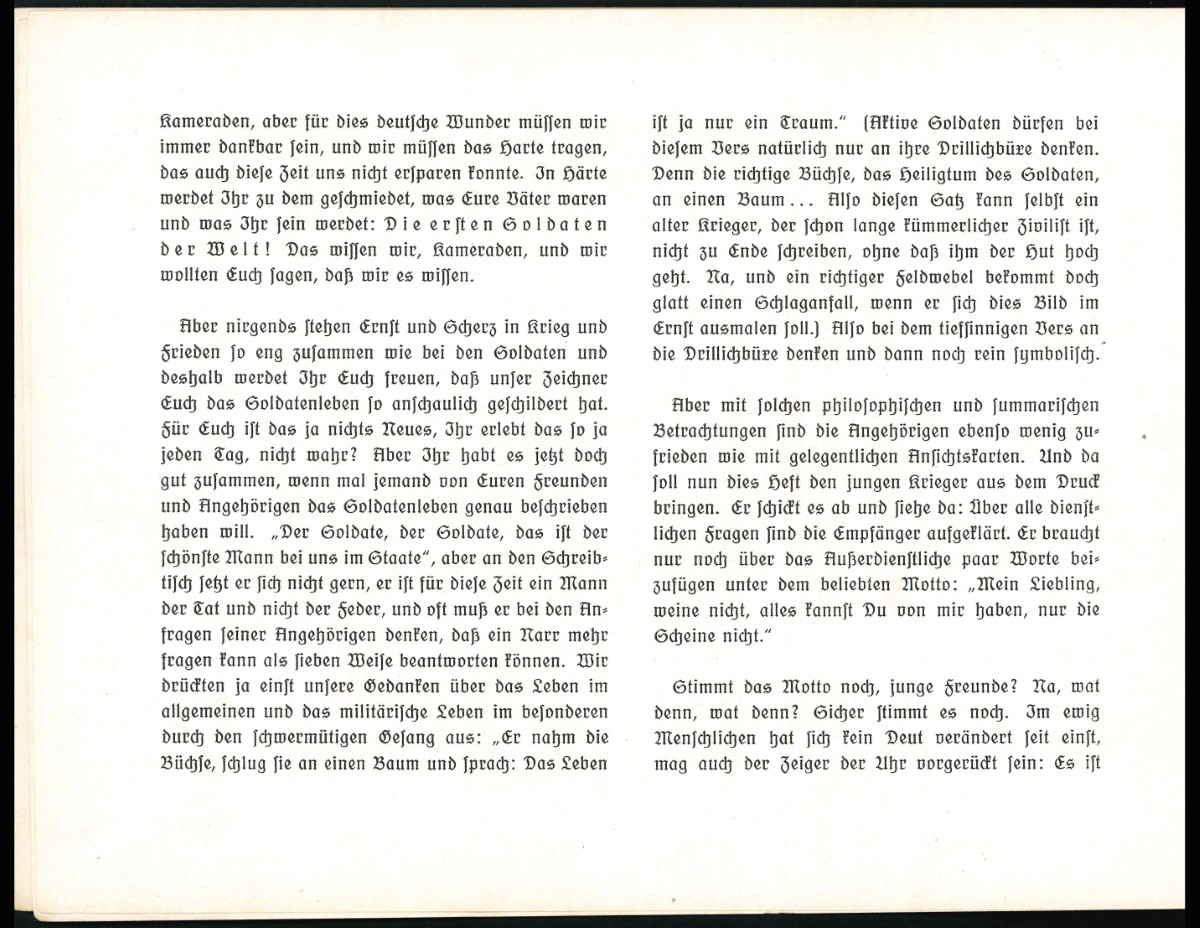
...comrades, but for this German miracle we must always be grateful, and we must bear the hardship that even this age could not spare us either. Through hardship you are being forged into what your fathers were and what you will become: the finest soldiers in the world! We know that, comrades, and we wanted to tell you that we know it.
But nowhere do seriousness and jest, in war and in peace, stand as closely together as among soldiers, and that's why you'll be pleased that our illustrator has depicted the soldier's life for you so vividly. For you, of course, none of this is new — you live it every day, don't you? But now you're well equipped for when one of your friends or relatives wants a precise description of the soldier's life. "The soldier, the soldier, he's the finest man in our land" — but he doesn't much care to sit at a writing desk; in these times he's a man of action, not of the pen, and when his relatives write with questions he often has to remind himself that a fool can ask more than seven wise men can answer. We once expressed our thoughts on life in general, and military life in particular, through that melancholy song: "He took his rifle, leaned it against a tree, and said: Life...
...is but a dream." (Active soldiers, naturally, may only think of their drill trousers when it comes to this verse. For the real rifle — the soldier's sacred object — leaned against a tree...? Not even an old warrior who has long since become a wretched civilian could finish that sentence without losing his temper. And a proper sergeant would have an outright stroke if he had to seriously picture that scene.) So: at this profound verse, think of the drill trousers, and take the rest purely symbolically.
But relatives are just as dissatisfied with such philosophical, sweeping reflections as they are with the occasional postcard. And that is where this booklet is meant to get the young soldier out of a bind. He sends it off, and lo and behold: the recipients are informed about all service-related matters. All he needs to add are a few words about off-duty life, under the well-loved motto: "My darling, don't cry, you can have anything of mine — except my pay."
Does that motto still hold true, young friends? Well, of course it does — why wouldn't it? In matters eternally human, not one jot has changed since the old days, even if the clock's hands have moved forward: it is...
PAGE 5
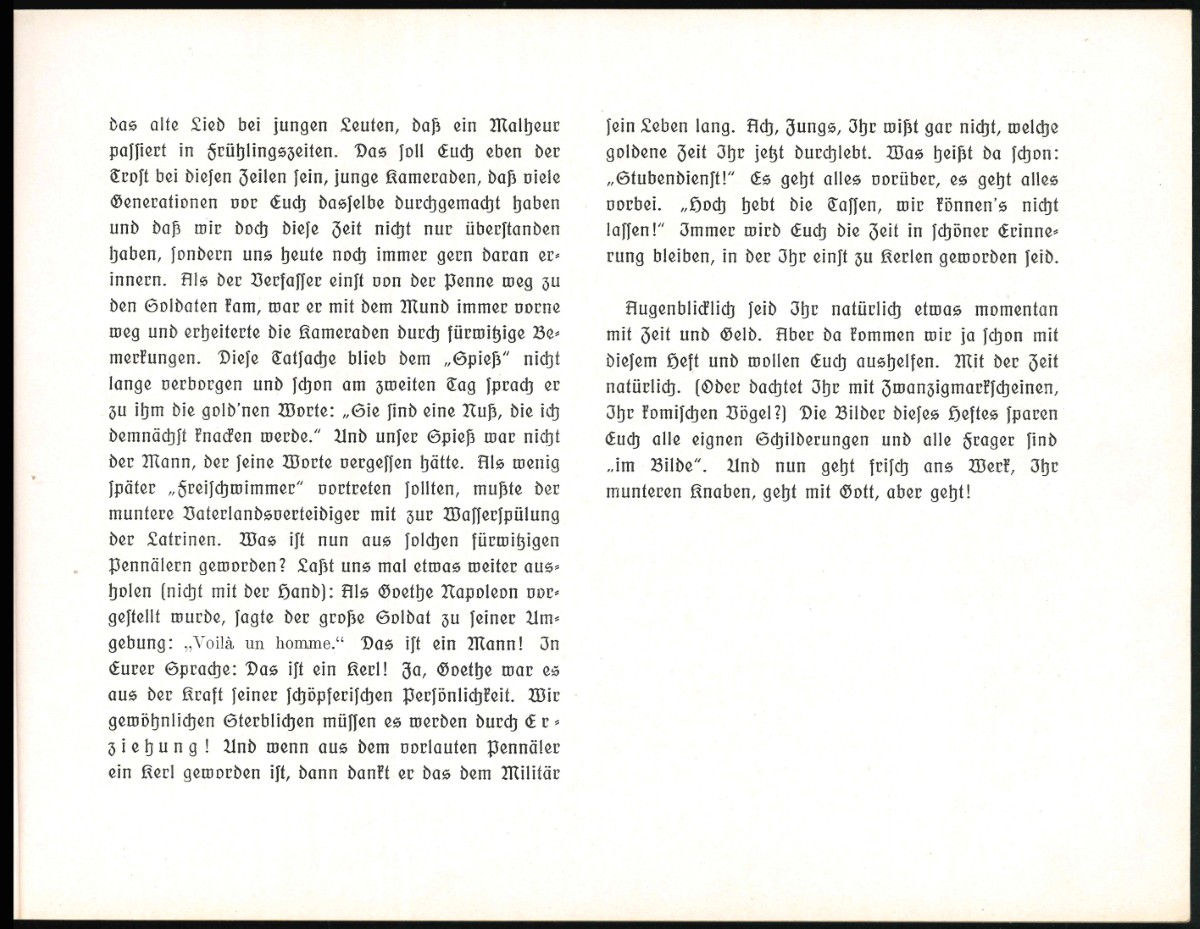
...it's the old song among young people, that a mishap happens in springtime. Let this be your comfort in these lines, young comrades: that many generations before you went through the very same thing, and that we didn't merely survive that time — we still, to this day, like to look back on it fondly.
When the author once came straight from school to the soldiers, he was always quick with his mouth and amused his comrades with cheeky remarks. This fact did not stay hidden from the "Spieß" [company sergeant major] for long, and already on the second day he spoke these golden words to him: "You're a nut I'll be cracking soon enough." And our sergeant major was not a man to forget his own words. Shortly afterward, when volunteers for "swim-certified" duty were called forward, our lively defender of the fatherland found himself assigned to flushing out the latrines.
So what became of such cheeky schoolboys? Let's take a bit of a broader view here (not with your hand): when Goethe was introduced to Napoleon, the great soldier remarked to those around him: "Voilà un homme" — that's a man! Or in your language: that's a real fellow! Yes, Goethe was that through the sheer force of his creative personality. We ordinary mortals have to become one through upbringing! And when a cheeky schoolboy has turned into a real fellow, he has the military to thank for it his whole life long.
Ah, lads, you have no idea what a golden age you're living through right now. What does "room duty" even amount to? Everything passes, everything goes by. "Raise your cups high, we just can't help ourselves!" You'll always look back fondly on this time, the time in which you once became real men.
At the moment, of course, you're a bit short on time and money. But that's exactly why we're stepping in with this booklet — we want to help you out. With time, that is, of course. (Or did you think we meant twenty-mark notes, you funny birds?) The pictures in this booklet spare you having to write your own descriptions, and everyone who asks will already be "in the picture." And now, get fresh to work, you lively lads — go with God, but go!
PAGE 6
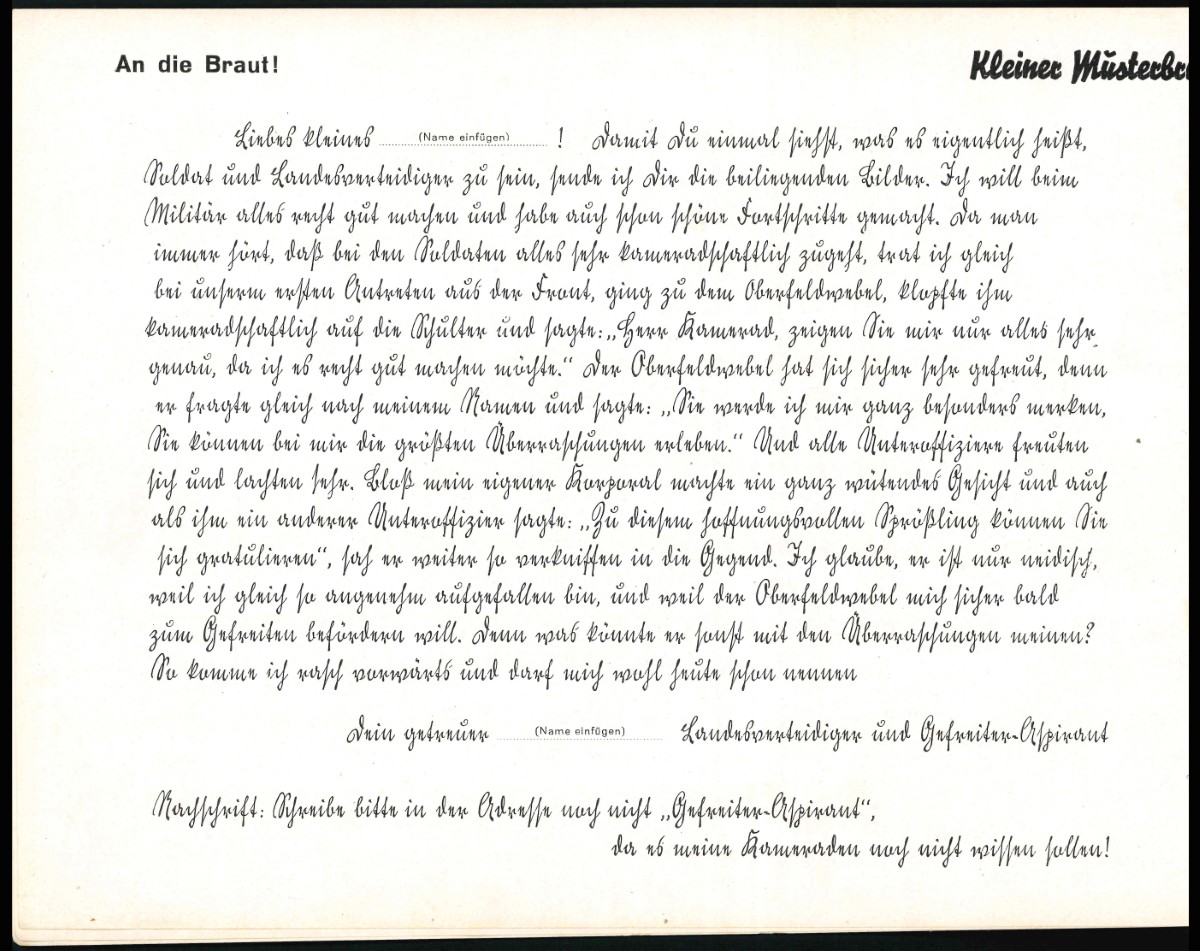
To the Bride!
"Little Sample-Letter-Writer for Beginners")
Dear little ______ (insert name)! So that you can finally see what it really means to be a soldier and defender of the fatherland, I'm sending you the enclosed pictures. I want to do everything really well in the military, and I've already noticed my own progress. Since one always hears that everything among soldiers goes strictly by command, right at our very first roll call I stepped out of the ranks, went up to the sergeant, clapped him smartly on the shoulder, and asked: "Sir, please show me everything very precisely, since I'd like to do it really well." The sergeant looked at me quite astonished, then asked my name at once and said: "You'll be a very special case for me — with me you can experience the biggest clean-up duties there are." And all the corporals were delighted and laughed heartily. Right away my own corporal looked at me very trustingly and...
...(I'm now doing everything right and am making really excellent progress, and because the sergeant wants to promote me to corporal soon. So what more could I possibly want with all this cleaning duty? I'm certainly moving up in the world, and may soon even become an officer.)
Your devoted ______ (insert name), defender of the fatherland and officer-candidate-to-be
P.S. Please, when you write back, don't address it to "officer-candidate" — my commander mustn't find out about that!
Given the cursive style, a few individual words above are my best interpretation rather than a certain reading — but the gist is clear: it's a mock sample letter poking fun at a naive recruit who thinks he's impressing his superiors, when in fact he's just landed himself latrine and cleaning duty.
PAGE 7
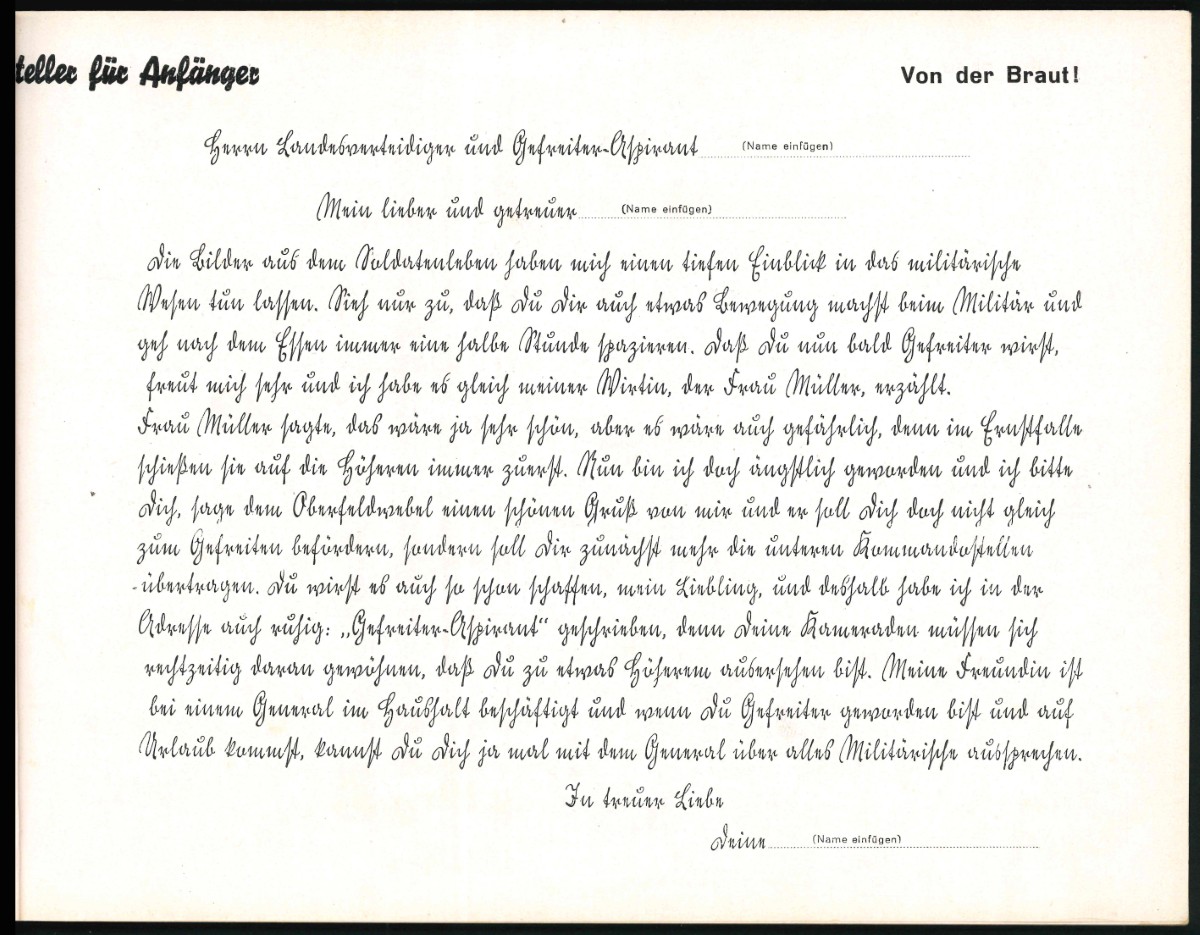
From the Bride!
To Mr. Defender-of-the-Fatherland and Officer-Candidate ______ (insert name)
My dear and faithful ______ (insert name),
The pictures of soldier life have now given me some insight into military affairs. Just be sure you also earn yourself some recognition in the military, and don't spend all your time after meals just taking pleasant strolls. That you'll soon be made an officer pleases me very much, and I told our landlady, Mrs. Müller, about it right away. Mrs. Müller said that was certainly very nice, but also dangerous, because in a real emergency it's always the officers who are first up on the front lines. Now I've become quite anxious about it, and I ask you: give the sergeant my kind regards, and tell him not to promote you to officer right away, but to first assign you, along with the other comrades, the usual duties. You know how to appreciate that, my darling, and that's why I made sure to write "Officer-Candidate" on the address, so that your comrades can all reassure one another that you're destined for something higher. My friend is employed in a general's household, and once you've become an officer and come home on leave, you'll be able to talk over all military matters with the general himself.
With faithful love, Your ______ (insert name)
A note on accuracy: this page is in handwritten cursive script, which is harder to read with full certainty than the printed pages — a few individual words above are my best reading rather than a guaranteed transcription, but the joke comes through clearly: the bride, worried officers die first in war, is quietly asking that her fiancé be kept doing ordinary grunt work instead of being promoted — while still addressing him as "Officer-Candidate" for bragging rights.
PAGE 8
To the accompaniment of the shared song:
"Soldier's life, oh yes, that's what you call fun"
we now march, all together, into the picture section.
PAGE 9
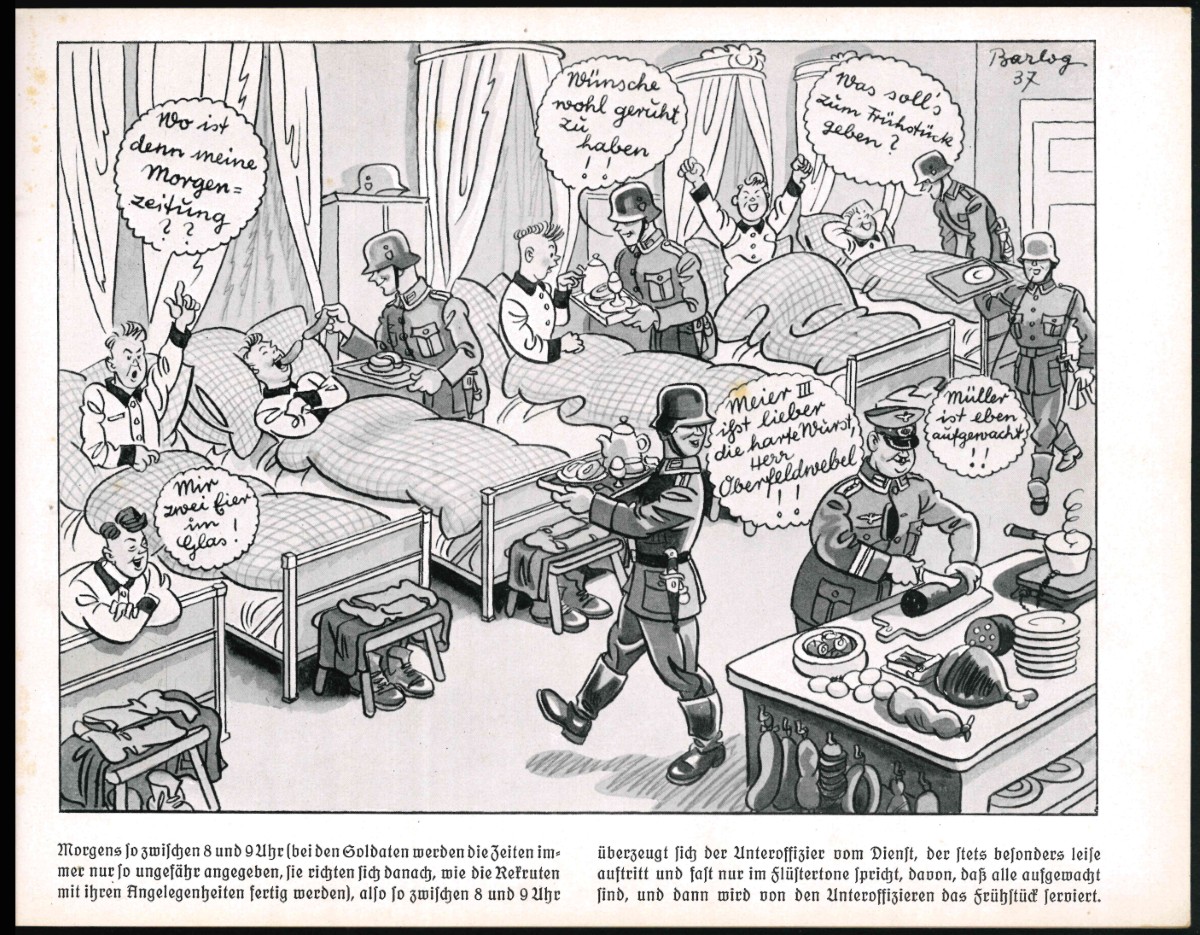
Speech bubbles (left to right, top to bottom):
"Now where's my morning paper?"
"I trust you slept well?"
"What shall we have for breakfast?"
"Two eggs in a glass for me."
"Meier III would rather have the hard sausage, Sergeant!!"
"Müller has just woken up!!!"
(Artist's signature, top right: "Barlog '37")
Caption below the illustration:
In the morning, somewhere between 8 and 9 o'clock (among soldiers, times are always given only approximately — they're geared to however long the recruits take to see to their own business), so somewhere between 8 and 9, the duty NCO — who always moves about especially quietly and speaks almost entirely in a whisper — satisfies himself that everyone is awake, and then breakfast is served to them by the NCOs.
This is obviously a satirical cartoon: the joke is the absurd reversal of real barracks life — recruits pampered in bed and waited on hand and foot, when in reality mornings in the army were the opposite (early, loud, and anything but gentle).
PAGE 10
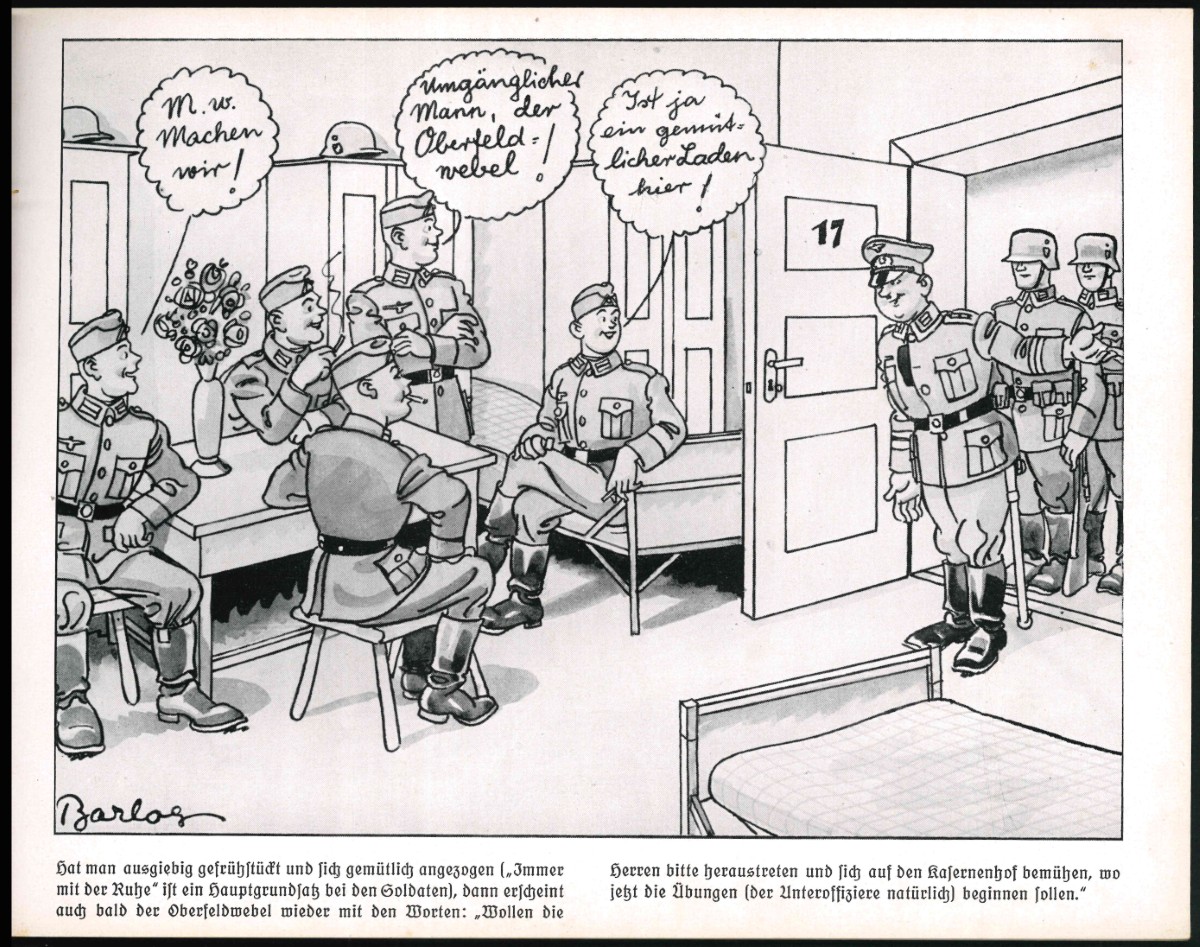
Speech bubbles (thought bubbles, left to right):
"Take it slow — that's what we'll do!"
"What an agreeable fellow, the sergeant!"
"This is quite the cozy outfit here!"
Caption below the illustration:
Once one has had a hearty breakfast and gotten dressed at a leisurely pace ("always nice and easy" is a chief principle among soldiers), the sergeant soon reappears with the words: "Would the gentlemen please step outside and make their way to the barracks yard, where the exercises (for the NCOs, naturally) are about to begin."
Same running joke as before — the recruits lounging about smoking and chatting, addressed with exaggerated politeness as "the gentlemen," is a satirical inversion of the actual harshness of barracks drill.
PAGE 11
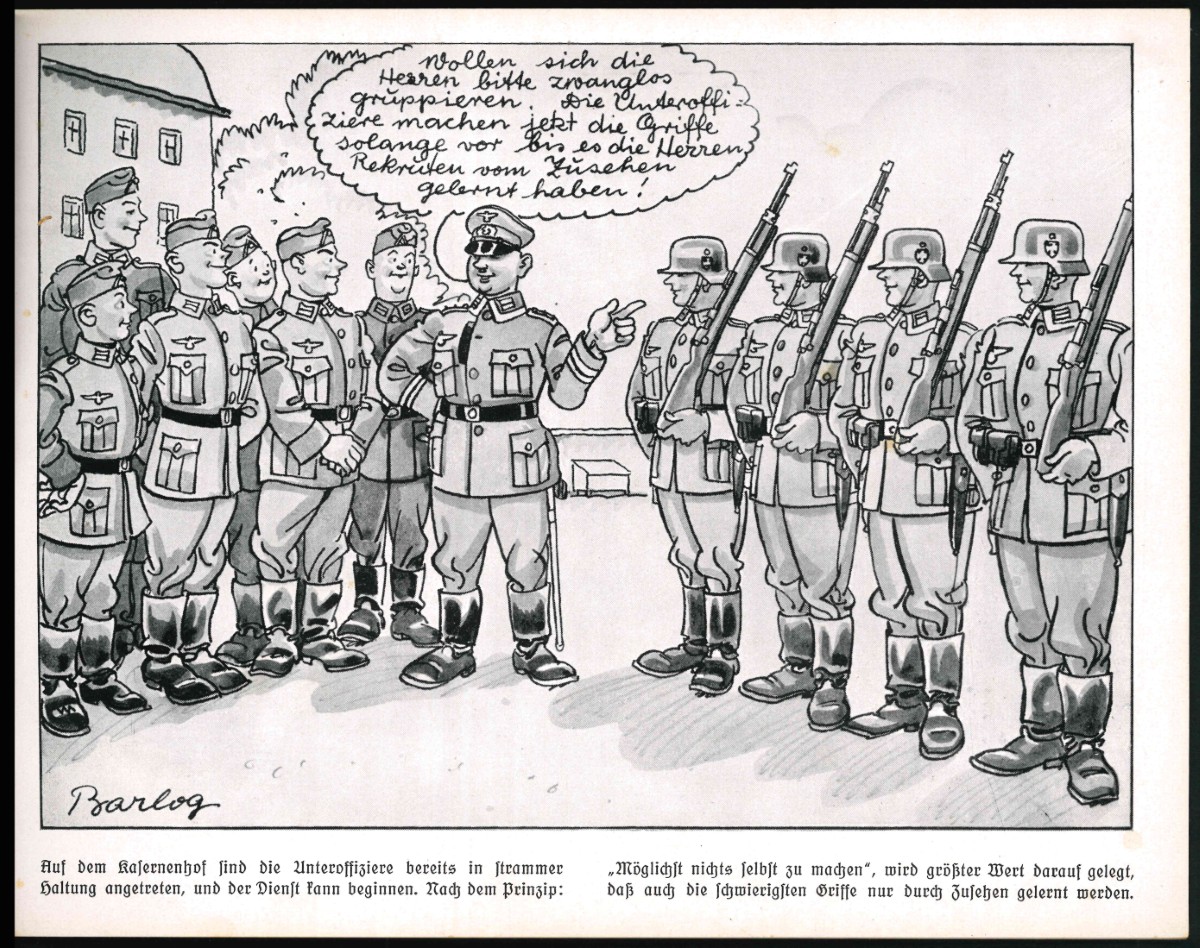
Speech bubble:
"Would the gentlemen please form up informally. The NCOs will now demonstrate the rifle drills for as long as it takes until the gentlemen recruits have learned them by watching!"
Caption below the illustration:
On the parade ground the NCOs have already fallen in, standing at rigid attention, and duty can now begin. Following the principle of "doing as little as possible oneself," the greatest importance is placed on ensuring that even the most difficult drill movements are learned purely by watching.
Same running joke continues: it's the NCOs doing the rifle drills while the "gentlemen recruits" merely observe — an absurd reversal of how basic training actually works.
PAGE 12
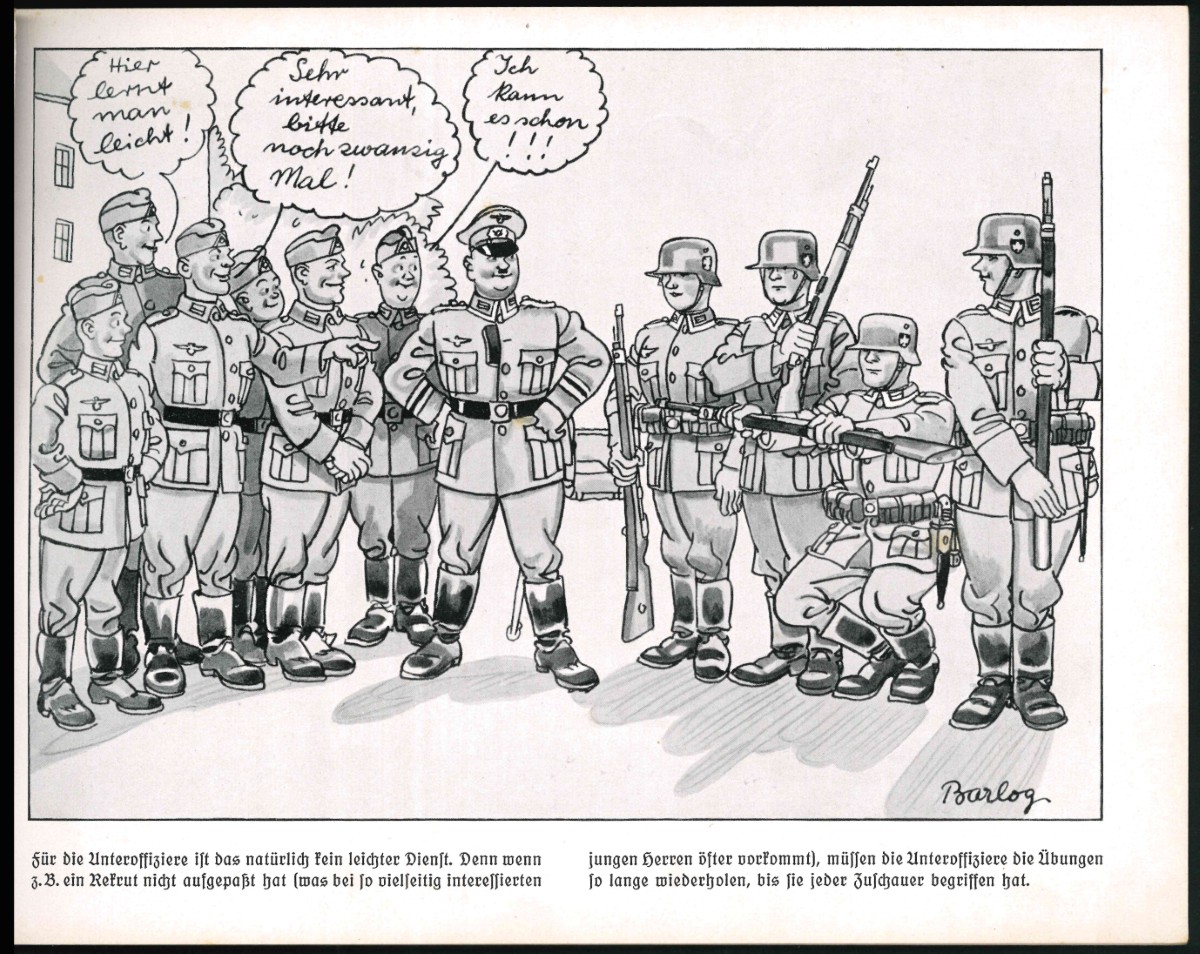
Speech bubbles (recruits watching):
"Here one learns easily!"
"Very interesting — please do it twenty more times!"
"I can already do it!!!"
Caption below the illustration:
For the NCOs, of course, this is no easy duty. For if, say, a recruit hasn't been paying attention (which happens rather often among such broadly interested young gentlemen), the NCOs have to keep repeating the drills for as long as it takes until every last spectator has grasped them.
Still the same joke: the NCOs are doing all the work and repeating drills endlessly for the "young gentlemen" recruits, who just watch and comment.
PAGE 13
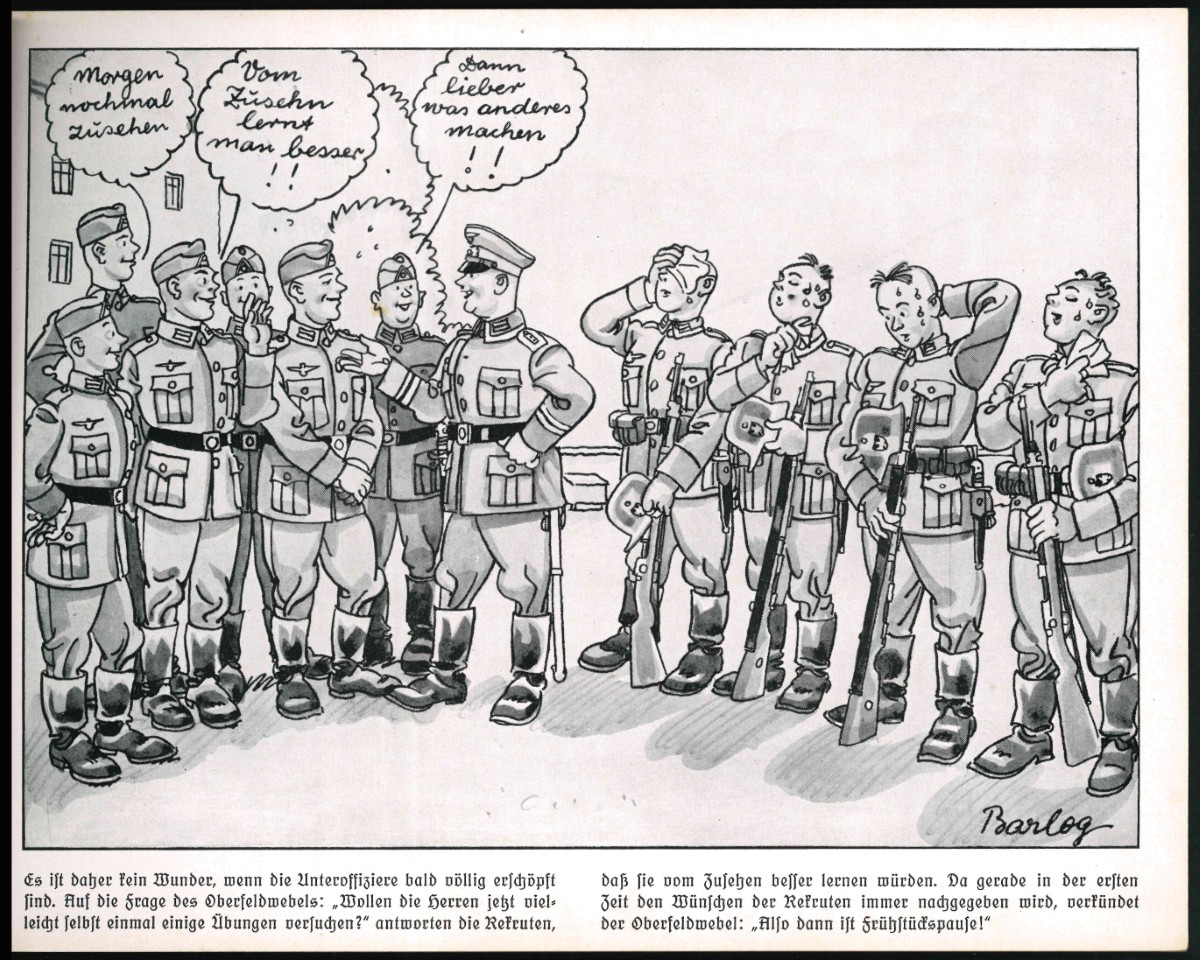
Speech bubbles (recruits, left group):
"We'll watch again tomorrow."
"One learns better by watching."
"Then we'd rather do something else!!"
Caption below the illustration:
It's therefore no wonder that the NCOs are soon completely exhausted. When the sergeant asks: "Would the gentlemen perhaps now like to try a few of the exercises themselves?" the recruits reply that they'd learn better just by watching. And since, especially in this early period, the recruits' wishes are always indulged, the sergeant announces: "Well then — breakfast break!"
The joke escalates: the exhausted NCOs, having done all the drilling themselves, are rewarded with recruits who refuse to practice — met with yet another break, mocking the exaggerated coddling of new soldiers.
PAGE 14
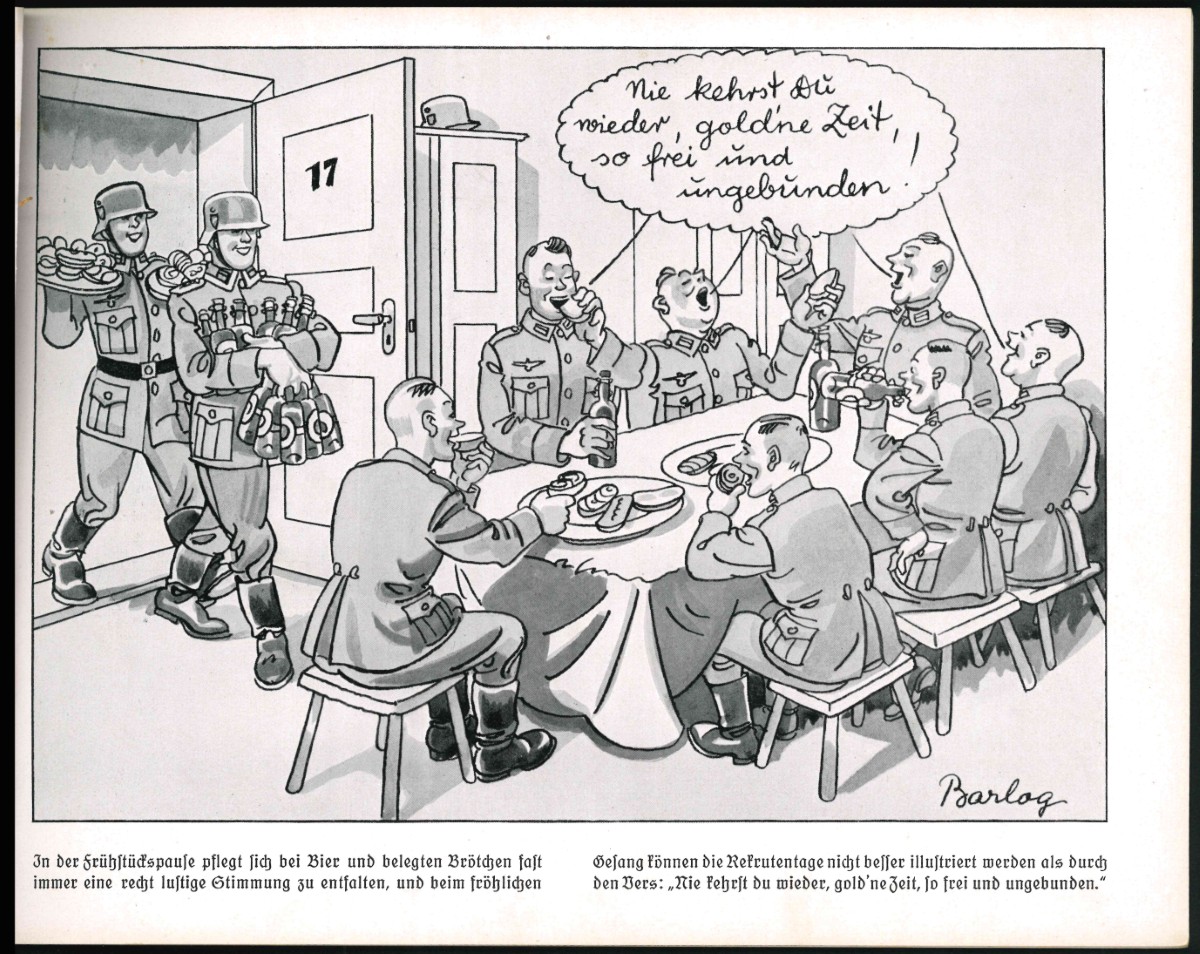
Speech bubble (sung by the recruits):
"Never will you return again, golden days, so free and unbound!"
Caption below the illustration:
During the breakfast break, a rather jolly mood tends to develop almost every time, helped along by beer and open-faced sandwiches, and amid the cheerful singing the recruits' days can hardly be better illustrated than by the verse: "Never will you return again, golden days, so free and unbound."
The running gag continues — recruits toasting and singing wistfully about their "carefree golden days," framing basic training as leisure rather than hardship.
PAGE 15
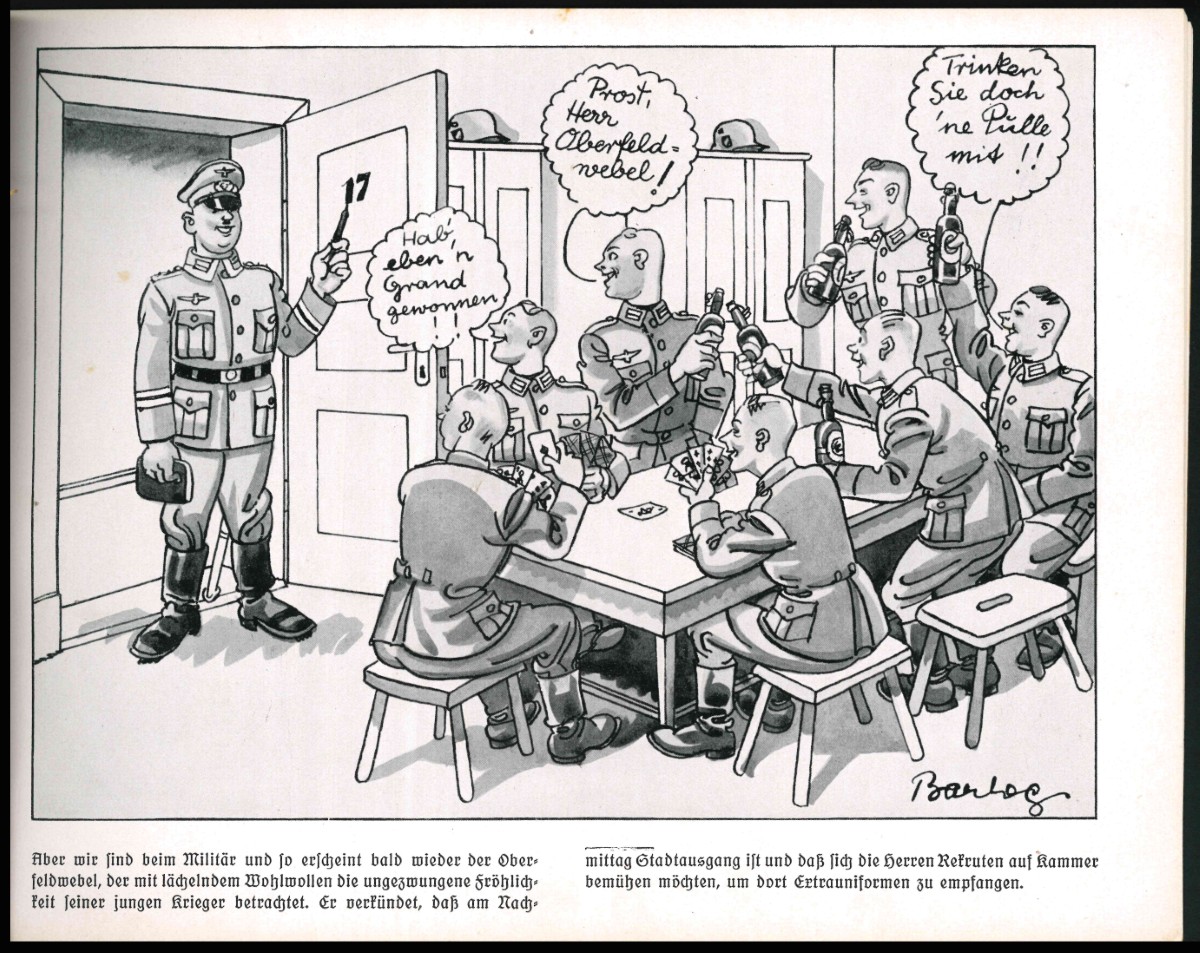
Speech bubbles:
"Just won a Grand slam!!" (a top bid in the card game Skat)
"Cheers, Sergeant!"
"Come have a bottle with us!!"
Caption below the illustration:
But we are in the military after all, so the sergeant soon reappears, regarding the easygoing merriment of his young warriors with a benevolent smile. He announces that there will be leave into town that afternoon, and that the gentlemen recruits should kindly make their way to the supply room to be issued extra dress uniforms.
Same running joke: cards, beer, and toasting the sergeant mid-morning, followed by more pampering — special uniforms and a trip into town.
PAGE 16
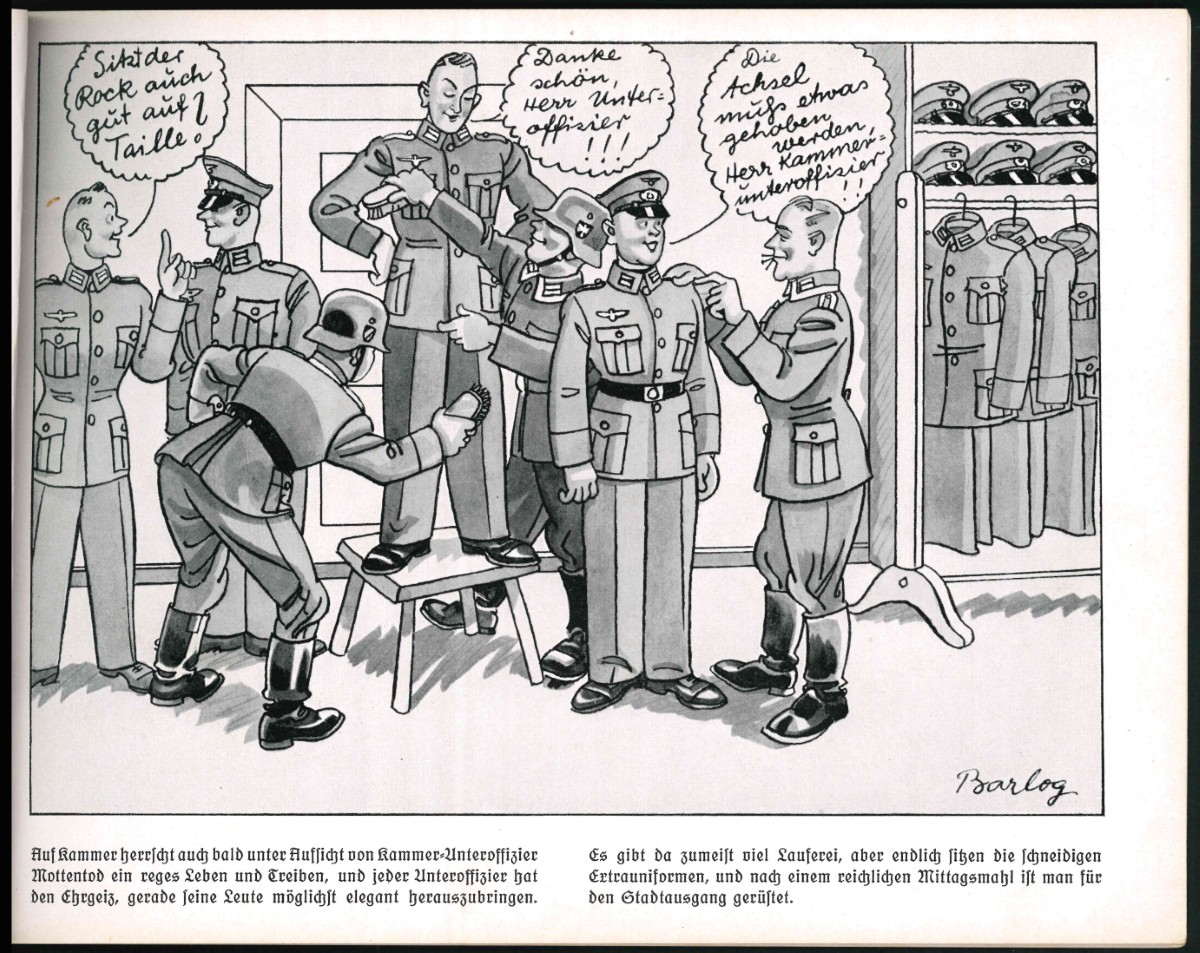
Speech bubbles:
"Does the jacket sit well at the waist too?"
"Thank you very much, Corporal!!!"
"The shoulder needs to be raised a bit, Quartermaster-Corporal!!"
Caption below the illustration:
In the supply room, too, a lively bustle soon breaks out under the supervision of Quartermaster-Corporal Mottentod ["Mothdeath" — a comic name, fitting for the man in charge of the uniform stores], and every corporal takes it as a point of pride to bring out his men looking as smart as possible. It usually involves a lot of running back and forth, but at last the dashing extra uniforms fit properly, and after a hearty midday meal, everyone is fully outfitted and ready for their trip into town.
Still the same satirical thread: fussy tailoring attention and a big lunch before the recruits even leave for town — the opposite of spartan army life.
PAGE 17
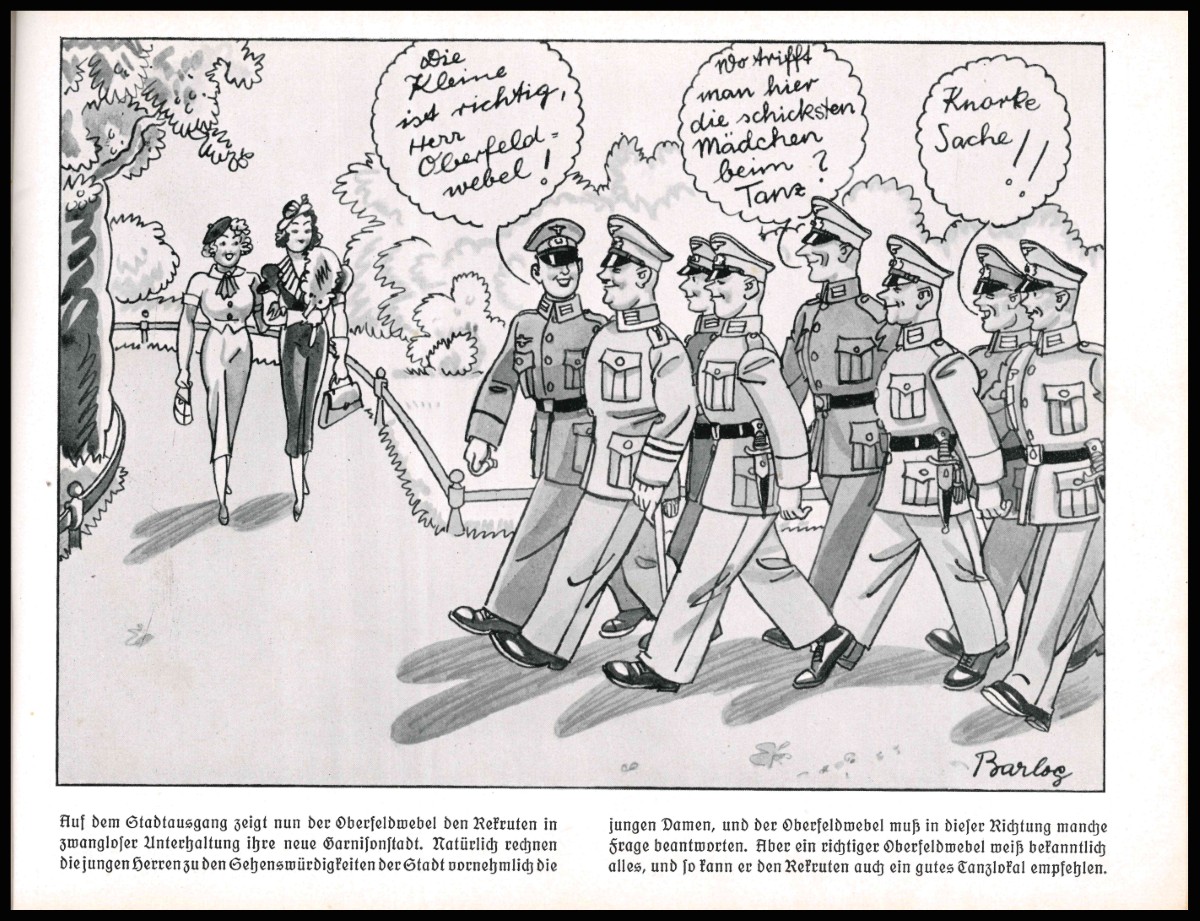
Speech bubbles:
"That one there looks just right, Sergeant!"
"Where does one find the smartest-looking girls around here for dancing?"
"Great stuff!!" ("knorke" — old Berlin slang for "excellent/swell")
Caption below the illustration:
Out on their afternoon leave, the sergeant now shows the recruits their new garrison town in relaxed conversation. Naturally, the young gentlemen count the young ladies chiefly among the town's sights worth seeing, and the sergeant has to field quite a few questions on that subject. But as everyone knows, a proper sergeant knows absolutely everything, and so he's able to recommend the recruits a good dance hall as well.
The gag continues: the ever-accommodating, all-knowing sergeant now doubles as a tour guide and matchmaking consultant for his recruits' night out.
PAGE 18
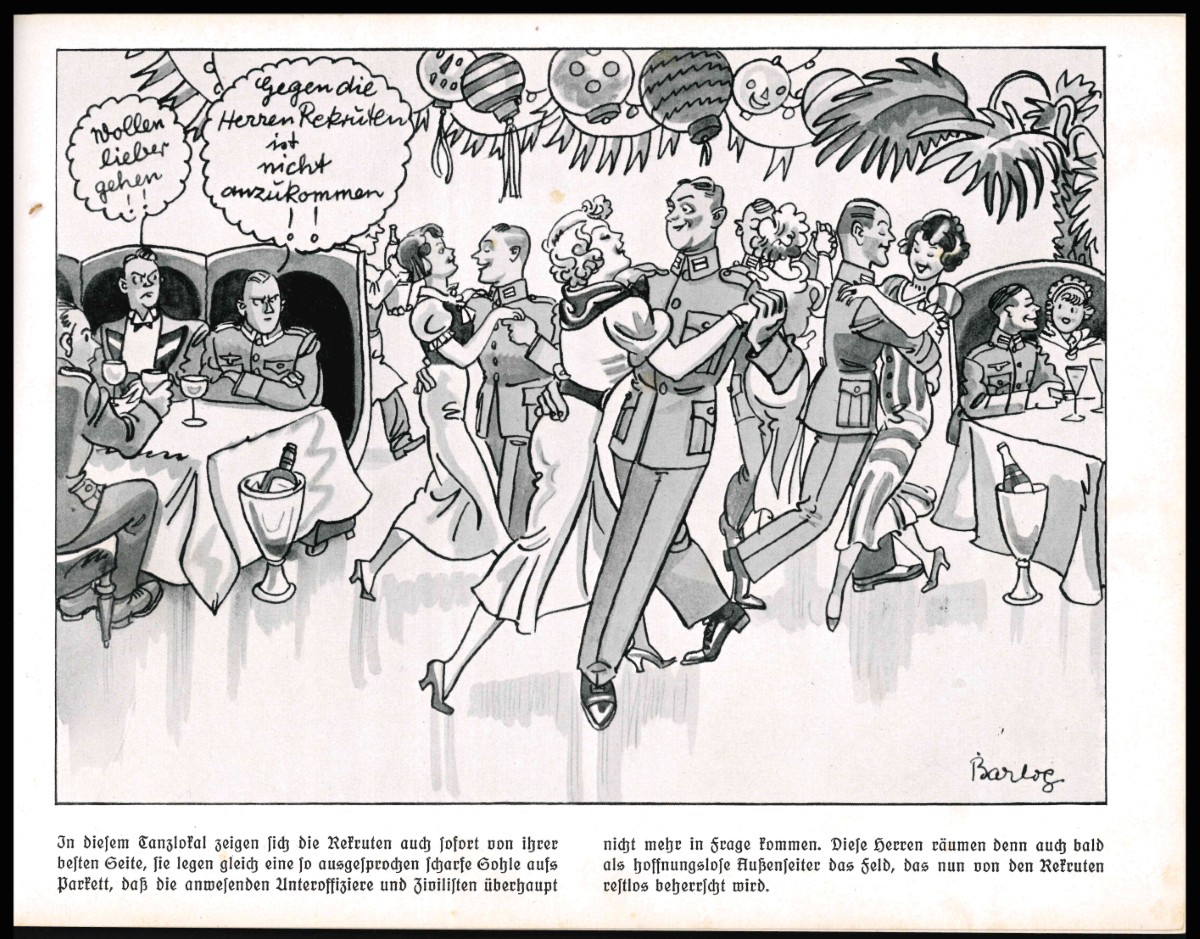
Speech bubbles (the disgruntled rivals at the table):
"We'd better just leave!!"
"There's no competing with the gentlemen recruits!!"
Caption below the illustration:
In this dance hall, too, the recruits immediately show themselves at their very best — they hit the dance floor with such striking flair that the NCOs and civilians present don't stand a chance at all. These gentlemen soon concede the field as hopeless also-rans, and the floor is now completely dominated by the recruits.
The running joke reaches its peak here: the once-lowly recruits are now portrayed as irresistible ladies' men, outshining everyone else in the room.
PAGE 19
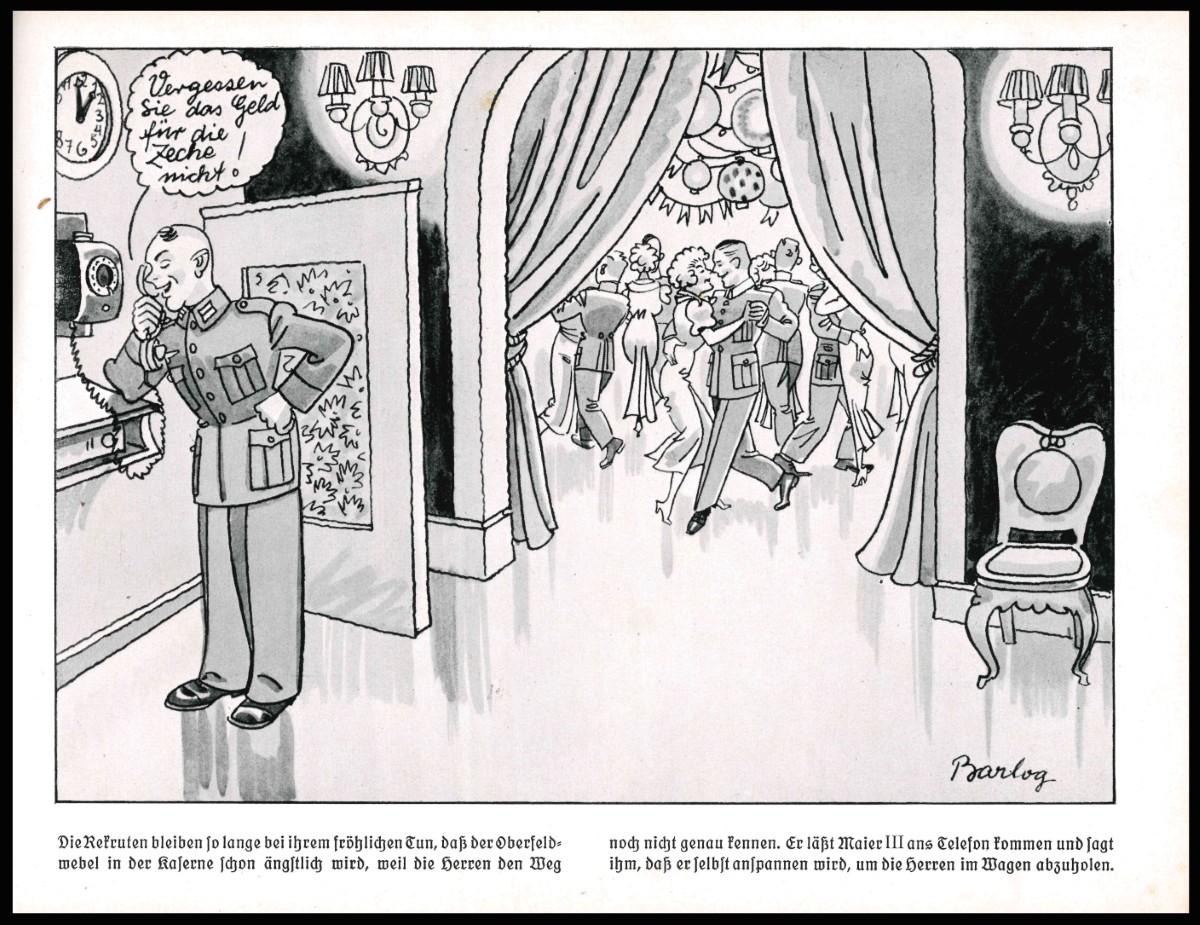
Speech bubble (sergeant on the phone):
"Don't forget the money for the bill!"
Caption below the illustration:
The recruits keep at their merrymaking for so long that back at the barracks the sergeant starts to grow anxious, worried that the gentlemen don't yet know their way back properly. He has Maier III called to the telephone and tells him that he himself will hitch up the carriage to come fetch the gentlemen in it.
The joke continues to escalate — now the sergeant is personally arranging a carriage pickup, fretting over his recruits like an overprotective host rather than a military superior.
PAGE 20
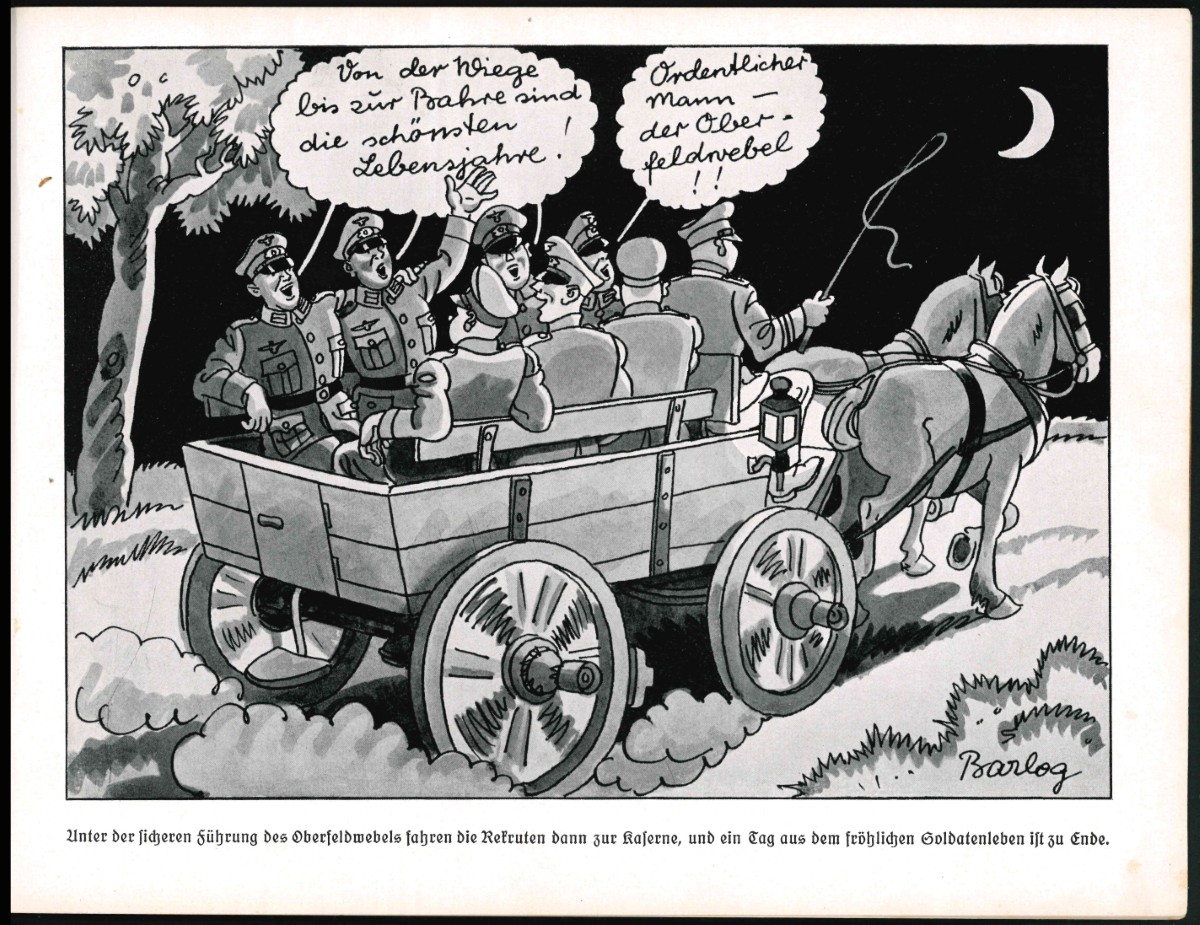
Speech bubbles (singing recruits):
"From the cradle to the grave, these are the finest years of life!"
"What a decent fellow — the sergeant!!"
Caption below the illustration:
Under the sergeant's sure guidance, the recruits are then driven back to the barracks, and a day out of the cheerful soldier's life comes to an end.
This closes out the comic sequence — the sergeant, having played waiter, tailor, tour guide, and now coachman, delivers his singing recruits safely home, capping off the booklet's running joke of a wildly pampered "typical" day in the army.
