
GERMAN PHILATELY
ABSENDER-FREISTEMPEL
This page was last updated
28-Sep-2026 04:55
ABSENDER-FREISTEMPEL
TYPE: A6
No. 23
"Gebühr bezahlt" in lower case letters
CITIES: "STUTTGART"
There are five versions of the A-6 type used ifrom 1926 onwards. They all consist of a circular stamp with the city along the upper edge, the date and postage value in the bridge section and some version of "Bezahlt" or "Gebühr Bezahlt" in the lower section.
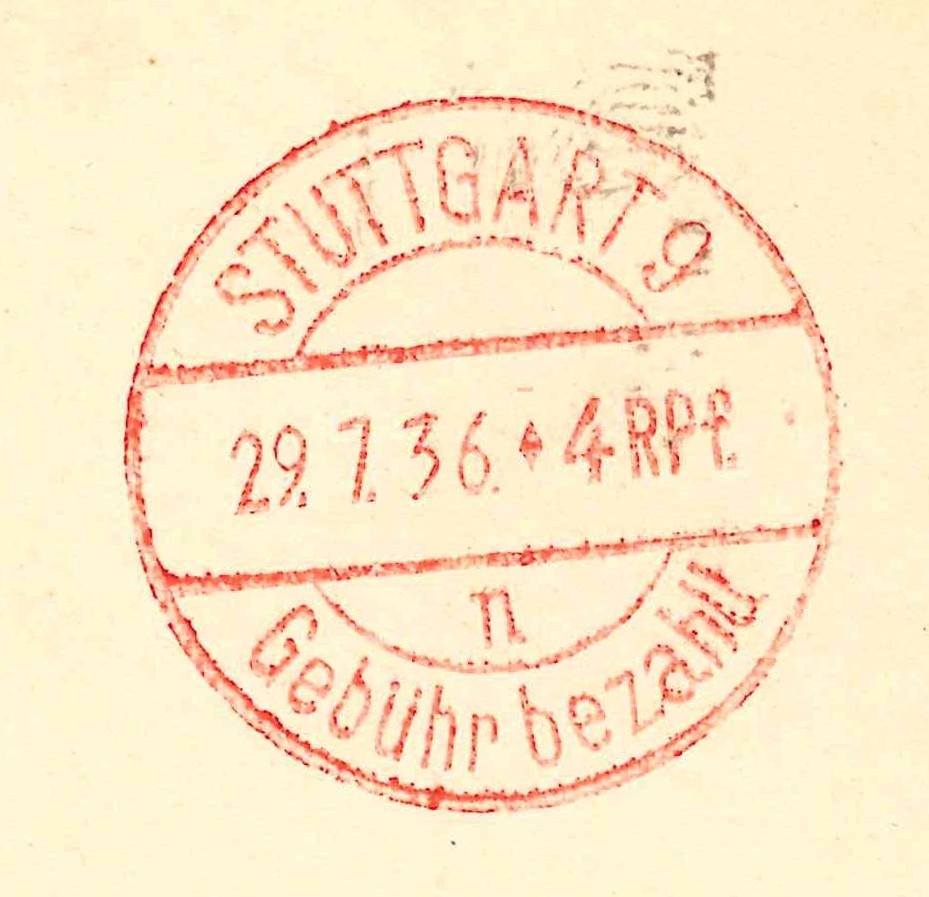
STUTTGART
1. DEUTSCHES AUSLAND-INSTITUT, STUTTGART
| CAT No. | FROM | TO | DATE | VALUE |
|---|---|---|---|---|
| A6: No. 23 | Stuttgart 9 | München 1 | 29th Jul 1936 | 4 Rpf |
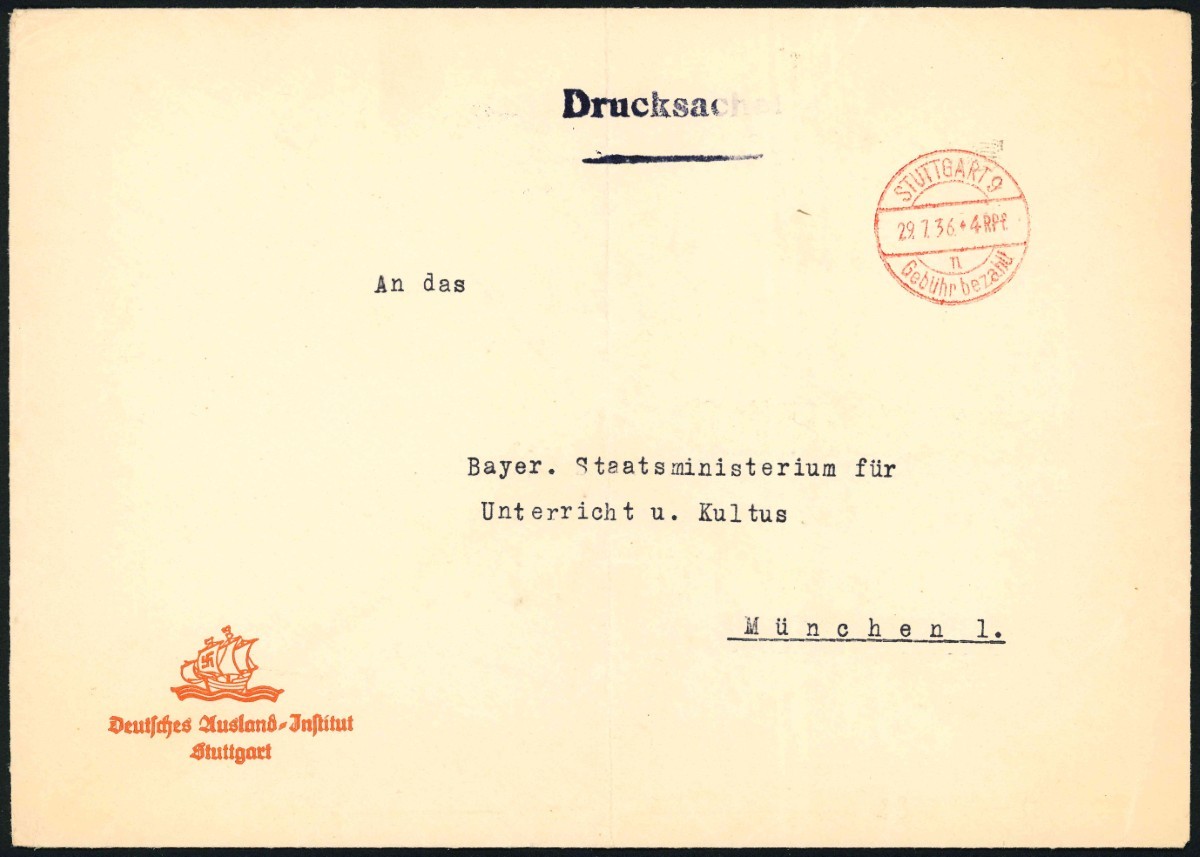

This cover is an official correspondence from the Deutsches Ausland-Institut (DAI) in Stuttgart, a Nazi-era propaganda and "ethnic German" organization. The DAI was founded on 10th Jan 1917, in Stuttgart by businessman Theodor Wanner as a "Museum and Institute for the Study of Germandom Abroad and the Promotion of German Interests Abroad." Through the 1920s, under Secretary-General Fritz Wertheimer, it operated in a liberal, Weimar-era tradition, mainly documenting and advising Germans living abroad (Auslandsdeutsche) and assisting prospective emigrants. It was funded chiefly by the Reich Interior Ministry, with smaller contributions from the Foreign Ministry, Württemberg, and the city of Stuttgart.
That changed abruptly after the Nazi seizure of power. In March 1933, SA men barred Wertheimer from the institute because of his Jewish ancestry, and chairman Wanner was physically attacked in his home. By mid-1933 the institute was reorganized under Nazi control, with the Stuttgart Nazi mayor Karl Strölin installed as president and Richard Csaki as secretary-general. From then on the DAI shifted from emigrant advice toward cultivating contacts with "Volksdeutsche" (ethnic German) groups abroad, increasingly serving as a propaganda and intelligence-gathering arm, feeding information on ethnic Germans abroad to Nazi agencies, supporting "racial policy," and participating in the regime's resettlement and "ethnic reordering" of Eastern Europe. In 1934 it even awarded its "Deutscher Ring" honor to Hitler. By 1943 it was formally subordinated to the SS-run Volksdeutsche Mittelstelle.
The cover was sent to the Bavarian State Ministry for Education and Culture (Bayer. Staatsministerium für Unterricht und Kultus) in Munich, i.e., official institute-to-ministry correspondence. The printed letterhead device, a ship with a sail bearing a swastika, was the DAI's emblem at the time, visually tying the institute to the regime's ideology.
After the war, U.S. occupation authorities classified the DAI as "incriminated" (belastet), but it was nonetheless reopened in 1951 under a new name, the Institut für Auslandsbeziehungen (ifa), which still exists today, a fact historians have noted allowed several of its "Volkstumswissenschaftler" to continue their careers despite the institute's wartime role.
Learn more about the DAI here , and here
2. ERWIN BÜHL
| CAT No. | FROM | TO | DATE | VALUE |
|---|---|---|---|---|
| A6: No. 23 | Stuttgart 13 | Aschaffenburg | 5th Mar 1935 | 3 Rpf |
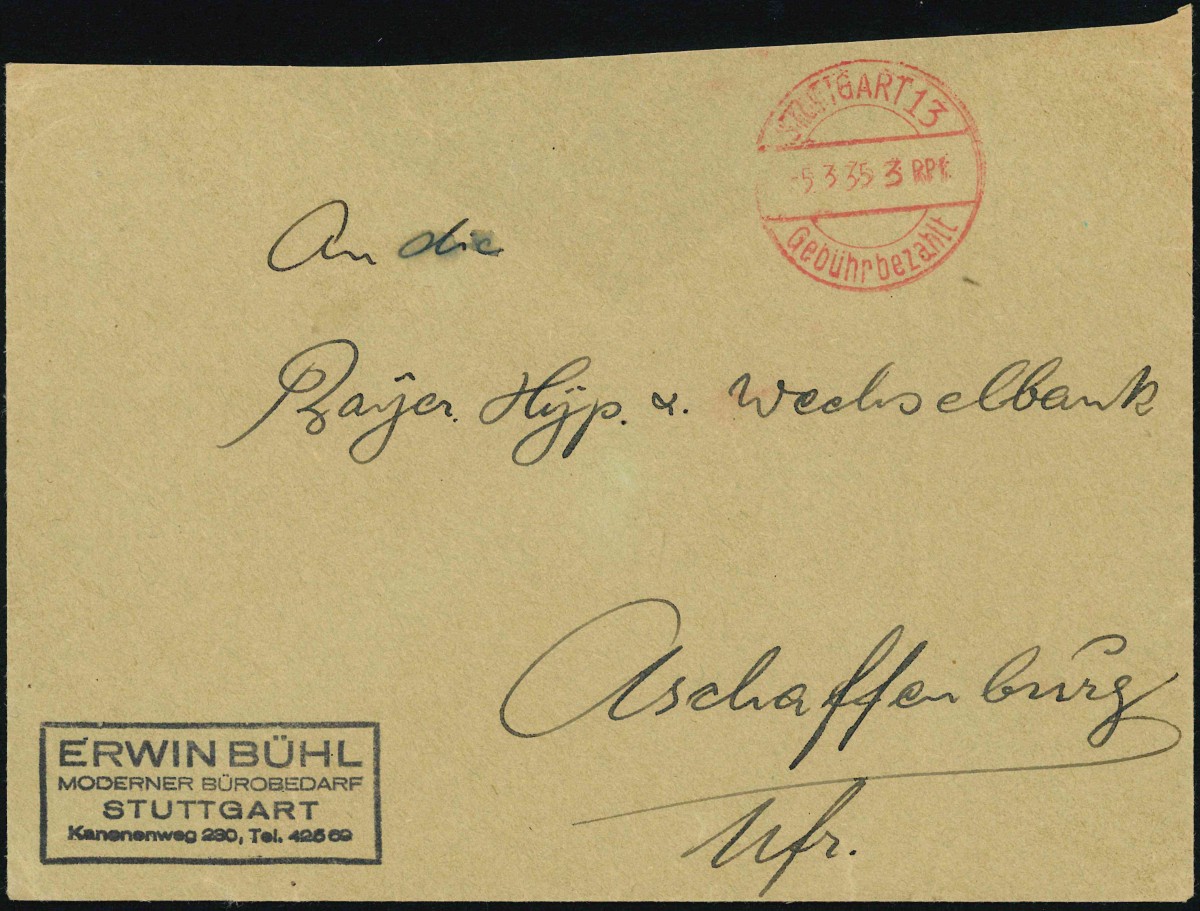
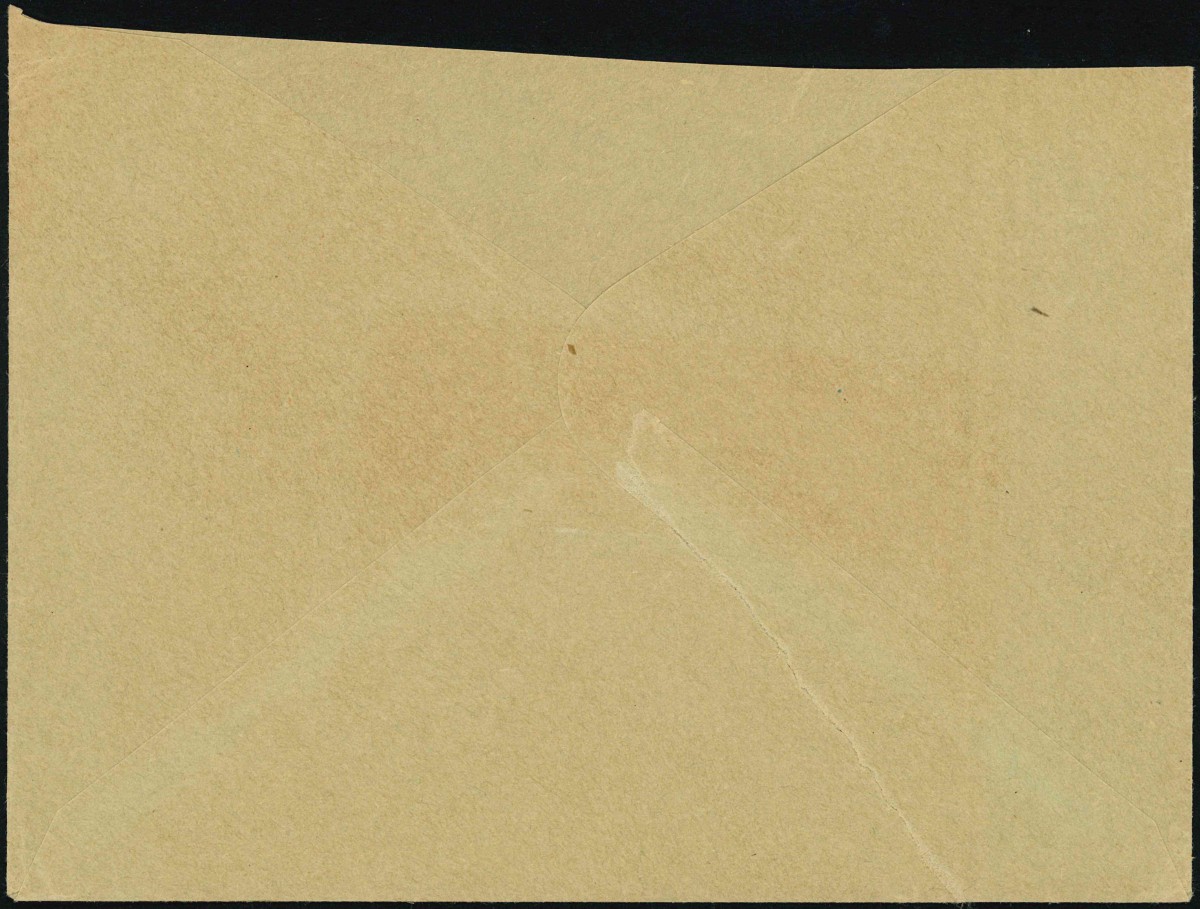
This cover, dated 5th Mar 1935, is a piece of business correspondence from Erwin Bühl, a Stuttgart office-supply company ("Moderner Bürobedarf," modern office supplies) based at Kanonenweg 230, sent to a branch of the Bayerische Hypotheken- und Wechselbank in Aschaffenburg, Bavaria
The company Erwin Bühl, it appears to have been a small, ordinary Stuttgart office-supply retailer/wholesaler of the period rather than a firm with a well-documented public history. The recipient bank, however, has a substantial and well-documented history: the Bayerische Hypotheken- und Wechsel-Bank was founded by royal decree on 1st Jul 1834, at the initiative of King Ludwig I of Bavaria, and began operations 1st Oct 1835, as one of Germany's earliest joint-stock banks, though under heavy state oversight (it also served as a Bavarian note-issuing bank until 1875). Its core business was concentrated in southern Bavaria, with expansion into northern Bavaria, including Aschaffenburg, starting around 1905–1921. The Aschaffenburg branch was later destroyed in Allied air raids between 1944 and February 1945. The bank itself survived as an independent institution until 1998, when it merged with Bayerische Vereinsbank to form HypoVereinsbank (HVB), which still exists today.
Learn more about the Bayerische Hypotheken- und Wechselbank AG and a Wikipedia article here
3. ALLGEMEINER ANZEIGER
FÜR BUCHBINDEREIEN STUTTGART
| CAT No. | FROM | TO | DATE | VALUE |
|---|---|---|---|---|
| A6: No. 23 | Stuttgart 3 | Zella-Mehlis | 20th May 1935 | 6 Rpf |
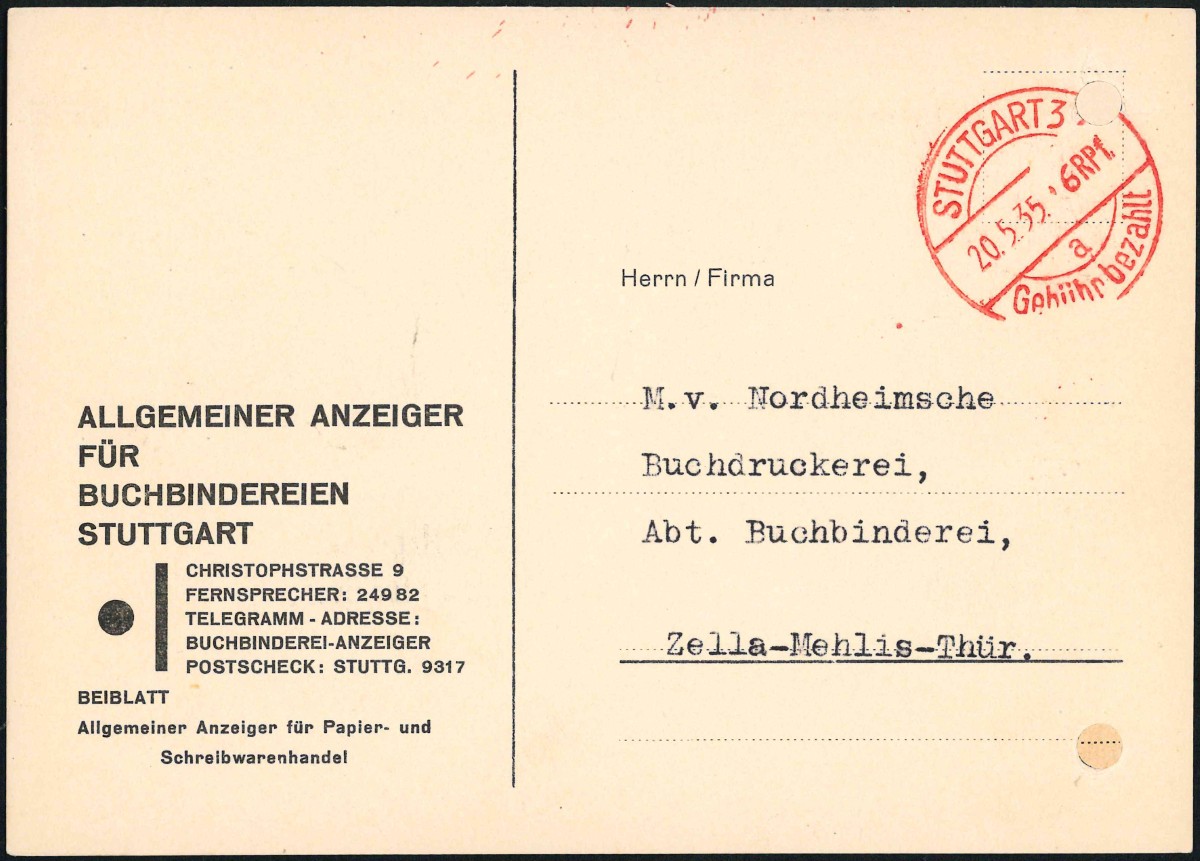
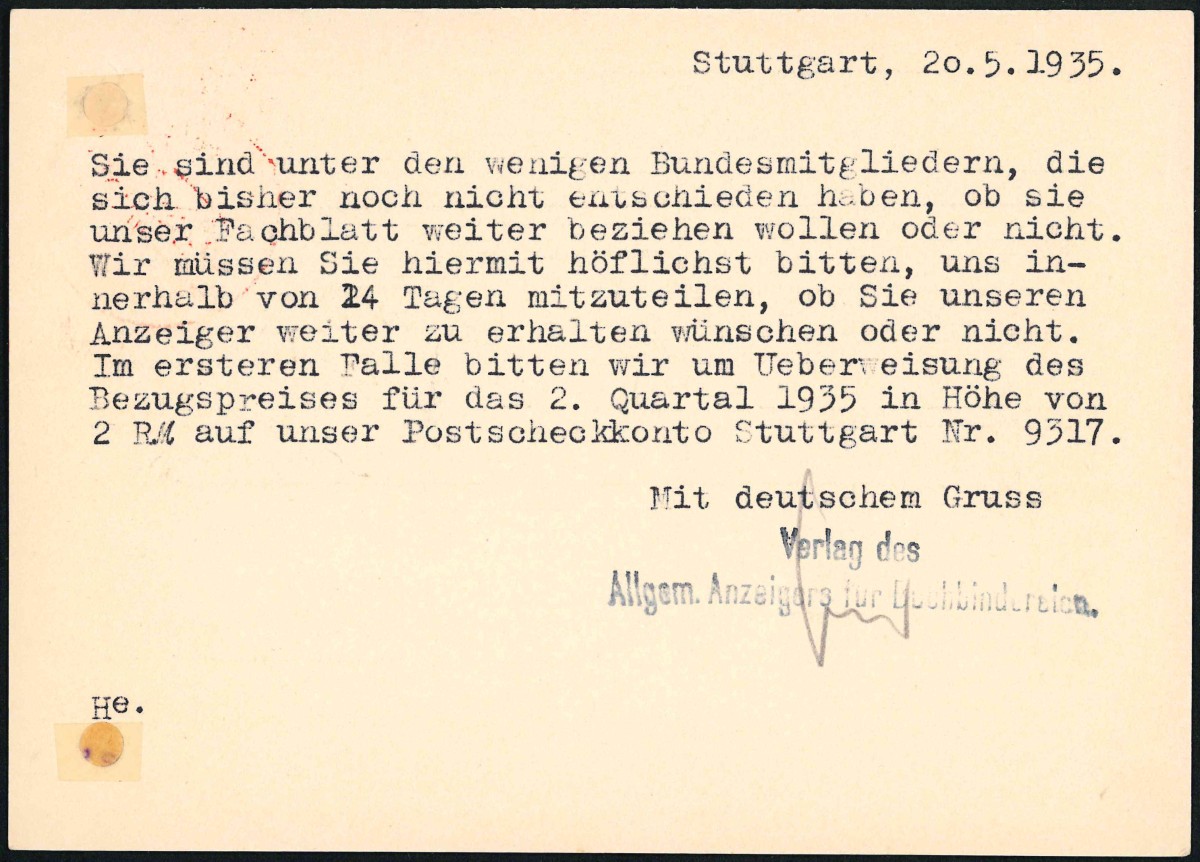
This is a printed-card business subscription renewal notice. The sender is the Allgemeiner Anzeiger für Buchbindereien, a Stuttgart-based trade journal for the bookbinding industry ("Mitteilungsblatt der deutschen Fachorganisationen des Buchbindergewerbes", the communications bulletin of the German bookbinding trade associations), based at Christophstraße 9, Stuttgart. It also published a supplement, the Allgemeiner Anzeiger für Papier- und Schreibwarenhandel (general gazette for the paper and stationery trade). The publication had a long run, traceable at least back to the 1890s, continuing under Stuttgart's Buchbinder-Verlag and later Hannover's Schlütersche Verlagsanstalt until 1979, when it was renamed Bindereport.
The printed message itself is a classic trade-journal renewal dunning notice, dated 20th May 1935: it tells the recipient they're one of the few "Bundesmitglieder" (association members) who haven't yet confirmed whether they want to keep receiving the journal, and asks them to reply within 24 days and to remit 2 Reichsmark for the second quarter of 1935 via the publisher's postal giro account (Postscheckkonto Stuttgart 9317), signing off "Mit deutschem Gruß" — a fairly neutral, period-typical valediction (not the politically loaded "Heil Hitler" some Nazi-era firms used, though still a marker of the time).
The recipient was M. v. Nordheimsche Buchdruckerei (Verlagsgesellschaft m.b.H.), in the bookbinding department, located in Zella-Mehlis, Thuringia, a printing/publishing firm that issued various academic works around 1930–31.
4. GLOBUS - DEUTSCHE BRIEFMARKEN-ZEITUNG
| CAT No. | FROM | TO | DATE | VALUE |
|---|---|---|---|---|
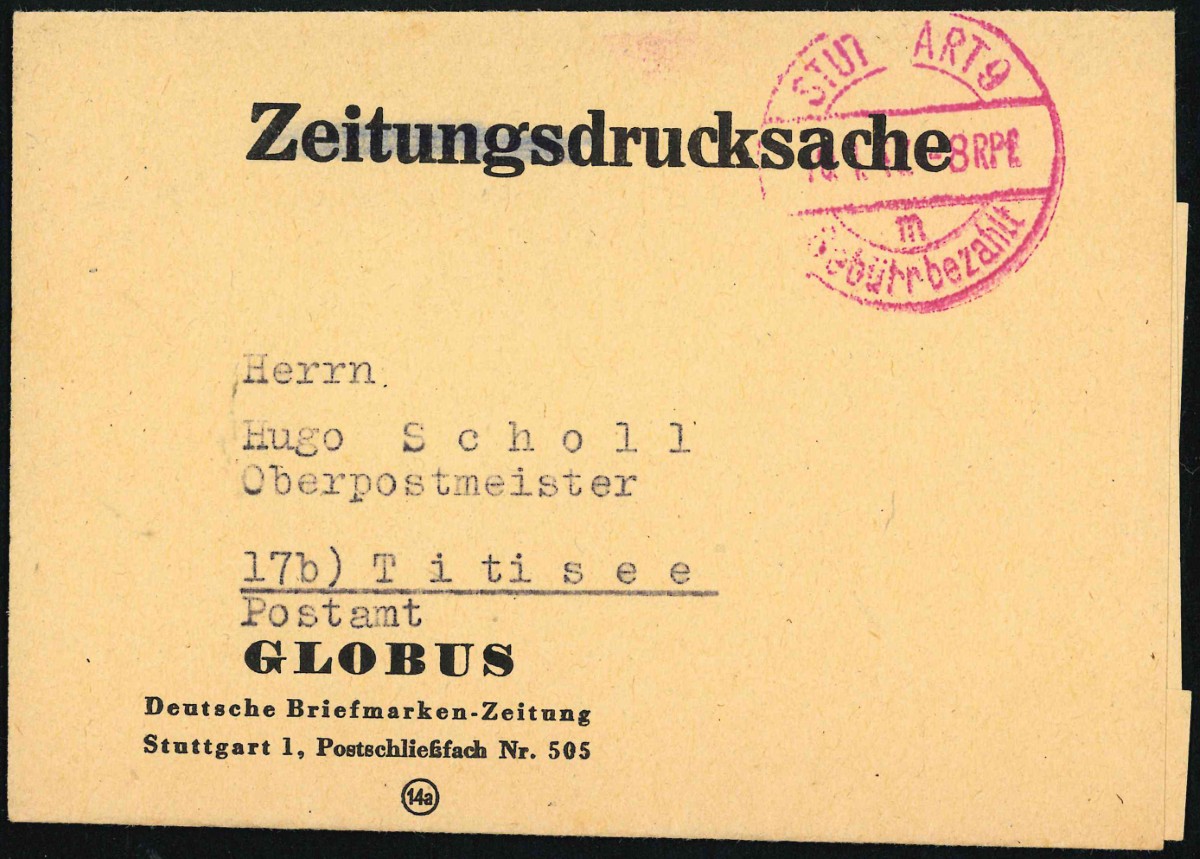
| A6: No. 23 | Stuttgart 9 | Titisee | UNKNOWN | 8 Rpf |
REFERENCES
1."DIE DEUTSCHEN POST- UND ABSENDER-FREISTEMPEL" - Handbuch und Katalog by Heiner Dürst and Gerd Eich. Heft Nr. 902. Wikipedia International Postage Meter Stamp Catalog Germany Page 1
