
GERMAN PHILATELY
ABSENDER-FREISTEMPEL
This page was last updated
06-Sep-2026 03:37

ABSENDER-FREISTEMPEL
TYPE D6
CITIES 'C'
BACKGROUND: The D-6 design was used from 1939 onwards and features a Reich's Adler (Empire Eagle) looking to its right with one wing extended along the bottom edge of the frame. Just above the eagle's wing is a hollow swastika and the stamp value is between the eagle's neck and the swasika.
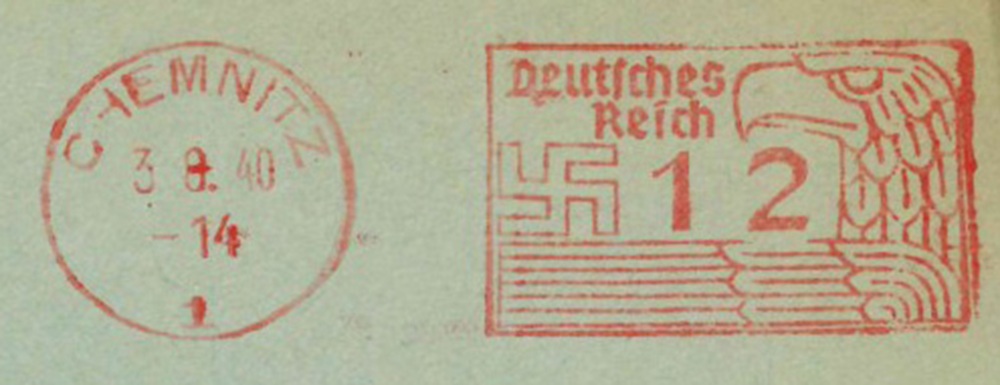
1. CHEMNITZ
1. DER OBERBUGERMEISTER DES STADT CHEMNITZ
| CAT No. | FROM | TO | DATE | VALUE |
|---|---|---|---|---|
| D6: No. 212 | Chemnitz | Meißen | 30th Aug 1940 | 12 Rpf |
See here for more examples from chemnitz
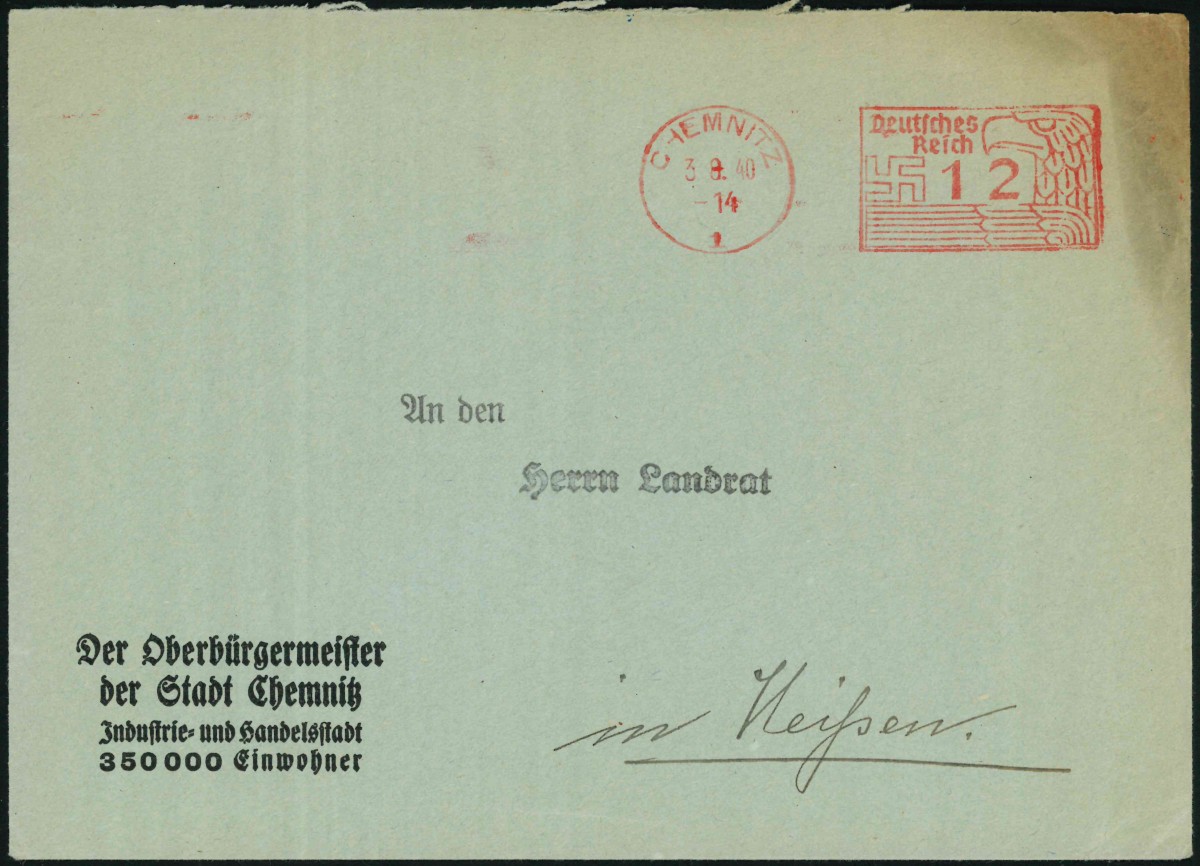

The example above features a ring type CDS from CHEMNITZ cancelled on 3rd Aug 1940.
The pre-printed sender block in the lower left, set in Fraktur (gothic blackletter) type, reads: Der Oberbürgermeister der Stadt Chemnitz - Industrie- und Handelsstadt - 350 000 Einwohner ("The Lord Mayor of the City of Chemnitz - Industrial and Commercial City - 350,000 inhabitants")
The destination addressee is partially printed and partially handwritten. The printed part says An den Herrn Landrat - "To the District Administrator", and someone has filled in in Meißen by hand. So this is a stock envelope kept on hand for the mayor's office to write to any Landrat (the head of a rural Landkreis), with the specific destination written in on a case by case basis. Here it went to the Landrat of Landkreis Meißen, about 60 km north-east of Chemnitz, both in the Free State of Saxony.
The notation Industrie- und Handelsstadt — 350 000 Einwohner line is a small piece of municipal civic boosterism printed straight onto official mail. Chemnitz in 1940 was one of Germany's most important industrial cities, sometimes called "the Saxon Manchester", and a major center of textile manufacturing, machine tools (especially the Wanderer, Auto Union, and later Siegmar works), and bicycle and motorcycle production. The 350,000 figure is not quite accurate for 1940; the 1939 census actually recorded around 334,000 inhabitants, and 350,000 was a rounded-up figure the city had been using since the late 1930s on stationery and signage. Quoting it on outgoing mail was a deliberate way of advertising the city's economic weight.
Like Dresden, Chemnitz was very heavily bombed with multiple raids in late 1944 and early 1945 destroying roughly 80% of the inner city. The administrative correspondence of the Oberbürgermeister's office, much of which was kept at the Rathaus, was significantly damaged. So pre-bombing official Chemnitz municipal mail in this kind of clean condition is the sort of thing that survives only in collectors' hands rather than in the city archive.
In August 1940 the Oberbürgermeister of Chemnitz was Walther Schmidt, a Nazi Party member who had taken the position in 1933 after the dismissal of Otto Härtwig [Source: wikipedia] . Like all big-city mayors under the Gleichschaltung, he served at the pleasure of the Party, and his correspondence with a Landrat in a neighboring district would have been routine bureaucratic businessmost likely about labor matters, food rationing administration, evacuee placement, or some shared regional issue.
REFERENCES
1. "DIE DEUTSCHEN POST- UND ABSENDER-FREISTEMPEL" - Handbuch und Katalog by Heiner Dürst and Gerd Eich. Heft Nr. 902. Wikipedia International Postage Meter Stamp Catalog Germany Page 1
