
GERMAN PHILATELY
ABSENDER-FREISTEMPEL
This page was last updated
06-Sep-2026 03:37

ABSENDER-FREISTEMPEL
Type: E1
Francotyp A
No. 42
CITIES: 'K'
Francotype A versions are determined by the format of the date in the city/date portion of the stamp. Type 'A's have a date format where the day, month, and year values are separated by large gaps. The Type 'A' can also be differentiated by the distance between the centre of the city/date and the centre of the value stamp frame (59 - 62mm) as below.
Type 42 stamps can be differentiated by the red asterisk preceeding the three numbers in the value stamp and old style digits: *000
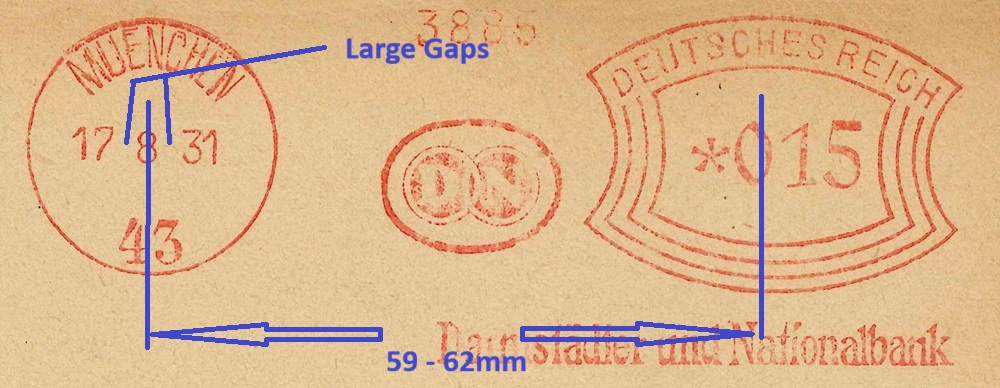
The Francotype 'A' meter stamps occur either with or without a 4 digit counter number. This number when present is either at the top (Type Ah- hoch or high) or in the centre (Type Am - Mitte or middle). Those without the counter number are Type Ao.
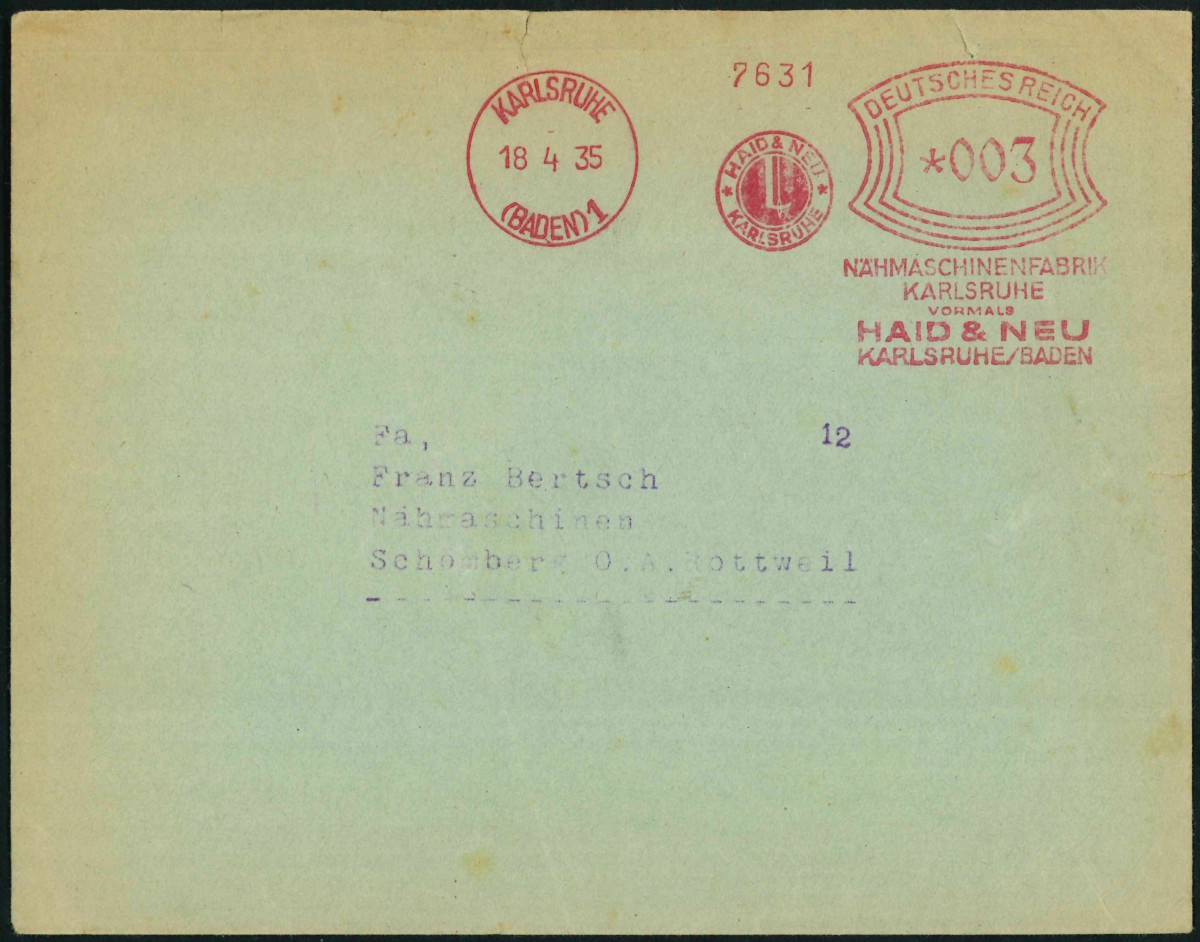
1. KARLSRUHE
NÄHMASCHINENFABRIK KARLSRUHE AG VORMALS HAID & NEU
| CAT No. | FROM | TO | DATE | VALUE |
|---|---|---|---|---|
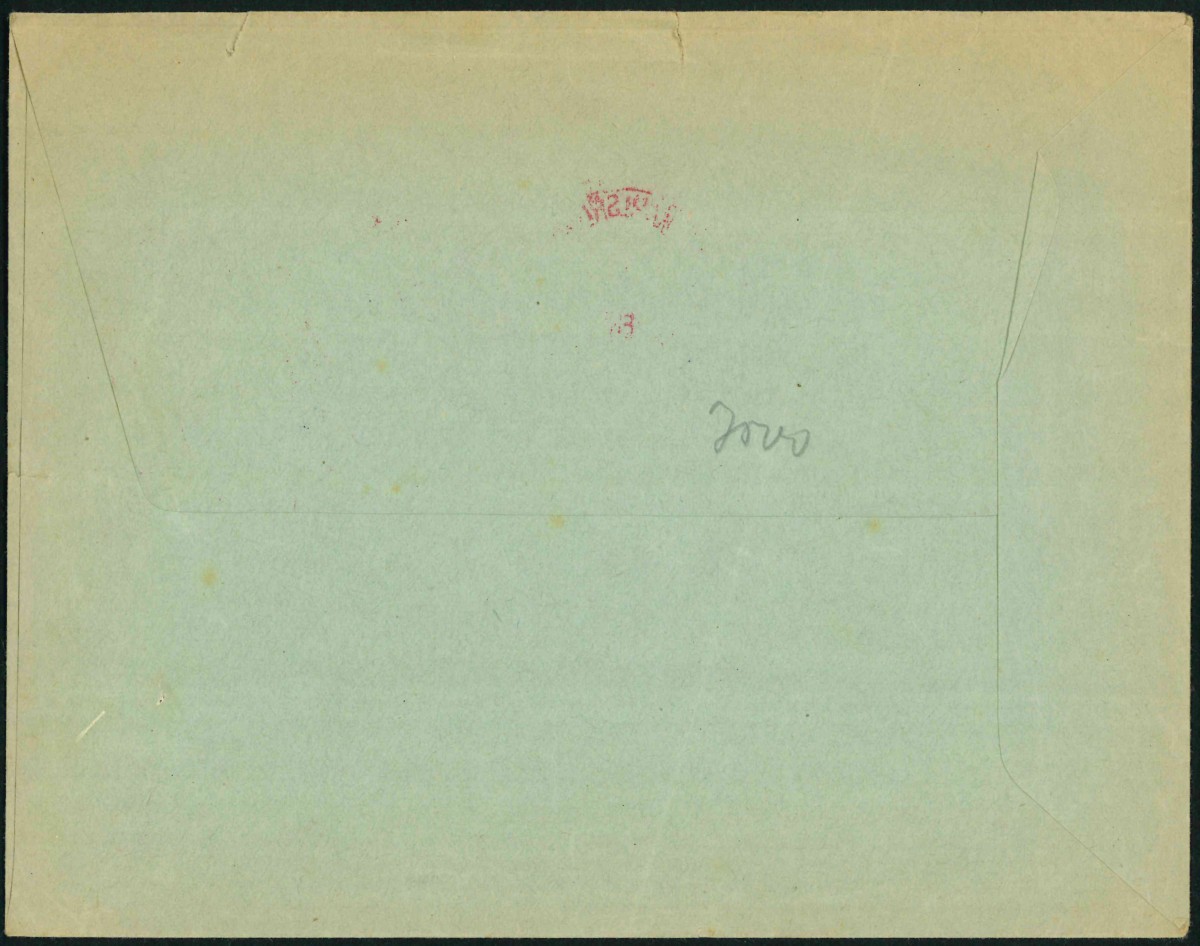
| E1: No. 42h | Karlsruhe | Rottweil | 18th Apr 1935 | 3 Rpf |
See here for more examples from Karlsruhe

In 1860, the mechanics Haid and Neu opened a workshop on Waldstraße in Karlsruhe. In 1862 they began manufacturing sewing machines. Stadtwiki Karlsruh Initially repaired machines, then manufactured their own designs using only hand and foot-powered machinery.
In 1868 they switched to steam engines, leading to a considerable increase in productivity. Between 1860 and 1870, approximately 5,000 sewing machines were produced in total. Stadtwiki Karlsruhe, the workshop on Waldstraße, quickly became too small, and the firm moved first to Akademiestraße, then to Lange Straße (today's Kaiserstraße).
In 1882 the firm was converted into a joint-stock company (Aktiengesellschaft). It was now named Nähmaschinenfabrik Karlsruhe AG vorm. Haid & Neu, with the Badische Bank of Mannheim among its shareholders. In 1883 a large modern factory was erected on what is today the Haid-und-Neu-Straße Stadtwiki Karlsruhe — a street that still bears the founders' names today in Karlsruhe.
In 1900 the company was making over 20,000 machines each year and celebrated the production of its 500,000th machine. Expansion continued rapidly and by 1908 the total production had passed 1 million machines. The 2 million mark was reached by 1921.
At the time of this cover's usage, Nähmaschinenfabrik Karlsruhe was Germany's most significant independent domestic sewing machine manufacturer, with decades of precision engineering tradition behind it. The firm was known across Europe for high-quality treadle and domestic machines — competing principally with Singer, Pfaff, and Gritzner.
In the early Nazi period, like all German manufacturers, it would have been subject to increasing state economic direction, workforce restructuring, and the effects of the gradual economic recovery under Nazi rearmament and motorisation programmes.
The Haid und Neu brand was sold to Singer in 1963. The factory was renamed again in 1967 as Singer Werke GmbH before it was finally closed in 1982.
2. KIEL
LANDSVERSICHERUNGSANSTALT SCHLESWIG-HOLSTEIN
| CAT No. | FROM | TO | DATE | VALUE |
|---|---|---|---|---|
| E1: No. 42h | Kiel 1 | Schaftstedt | 19th Sep 1935 | 24 Rpf |
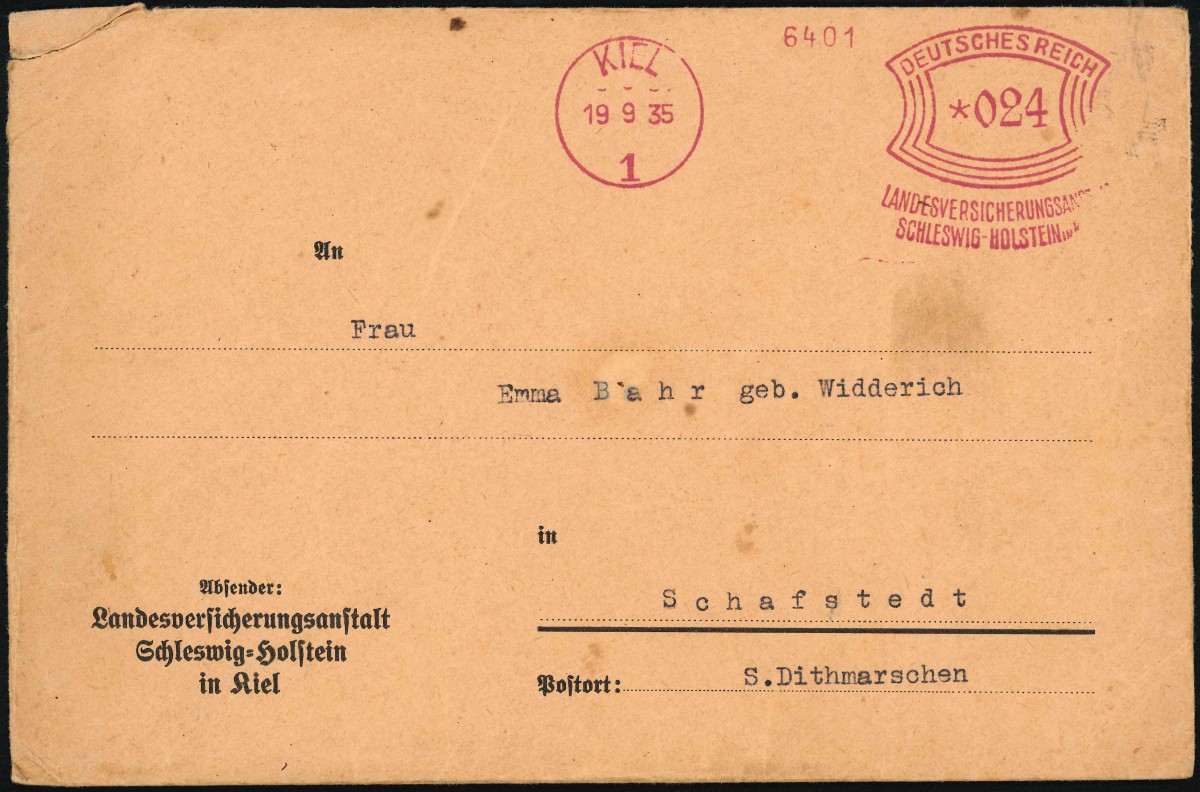
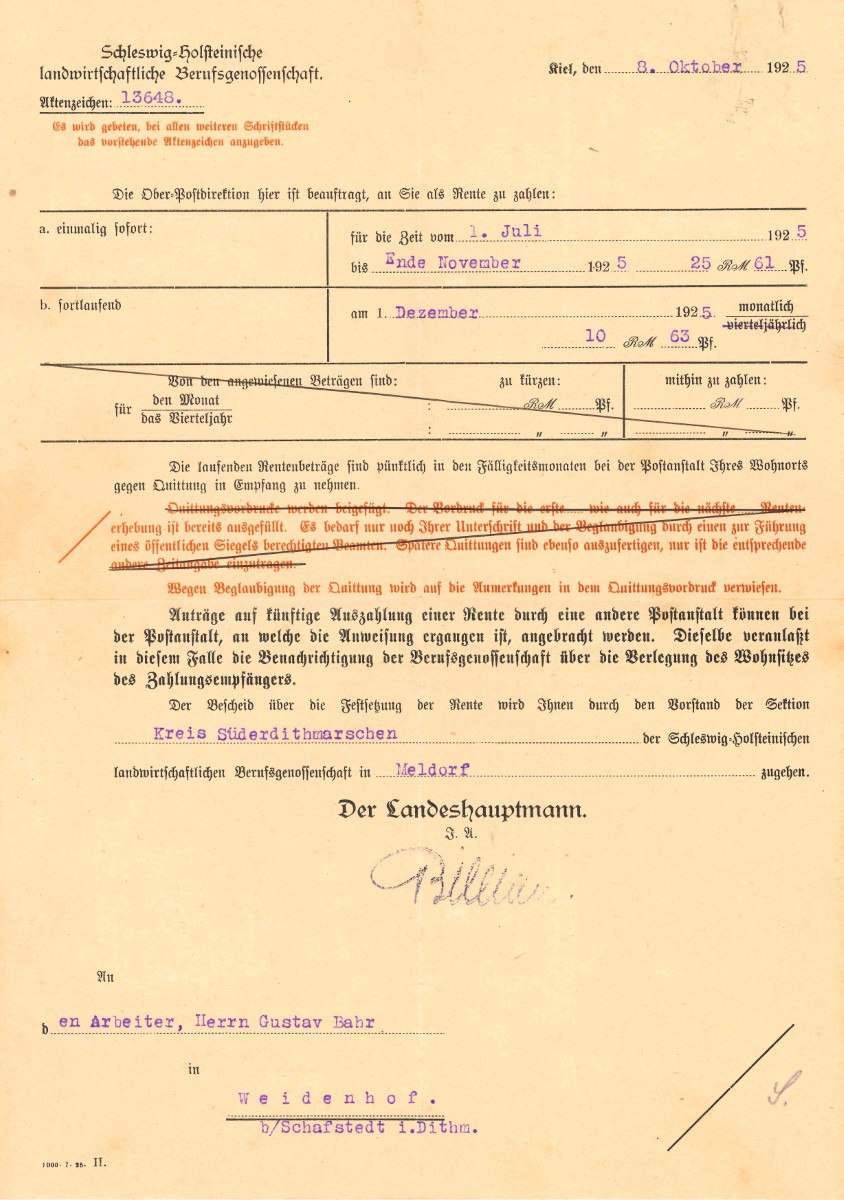
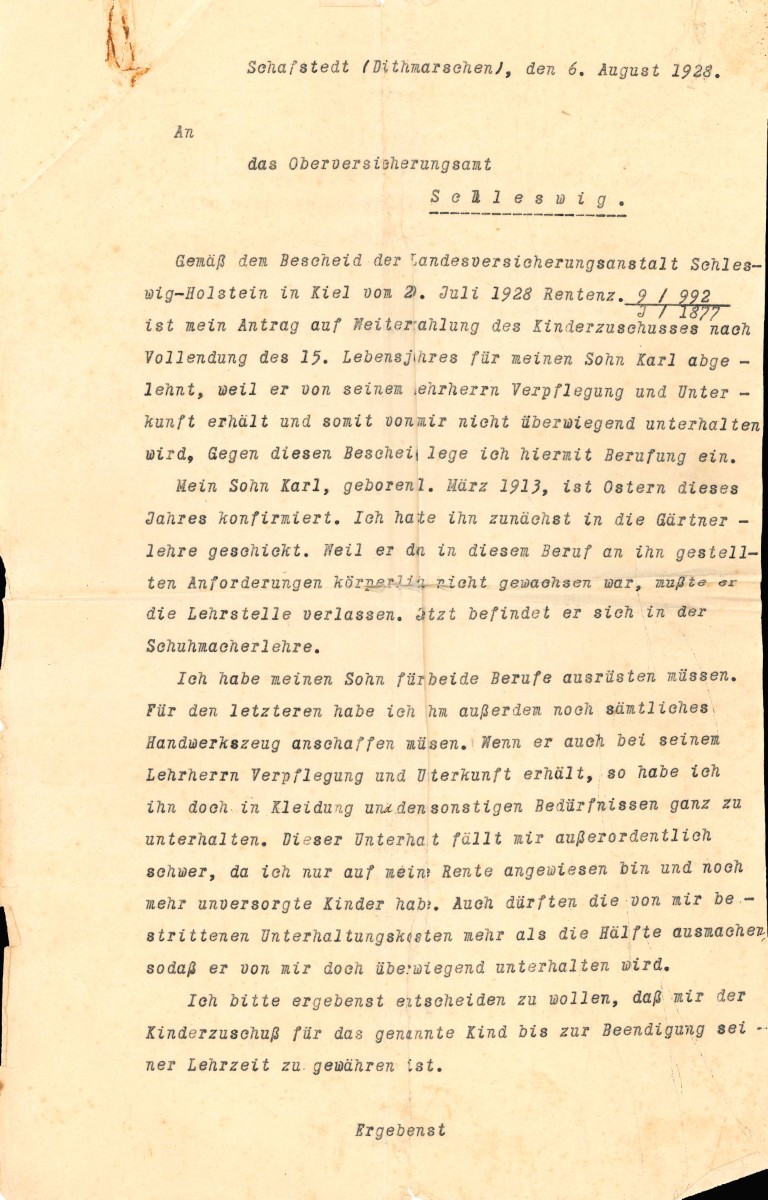
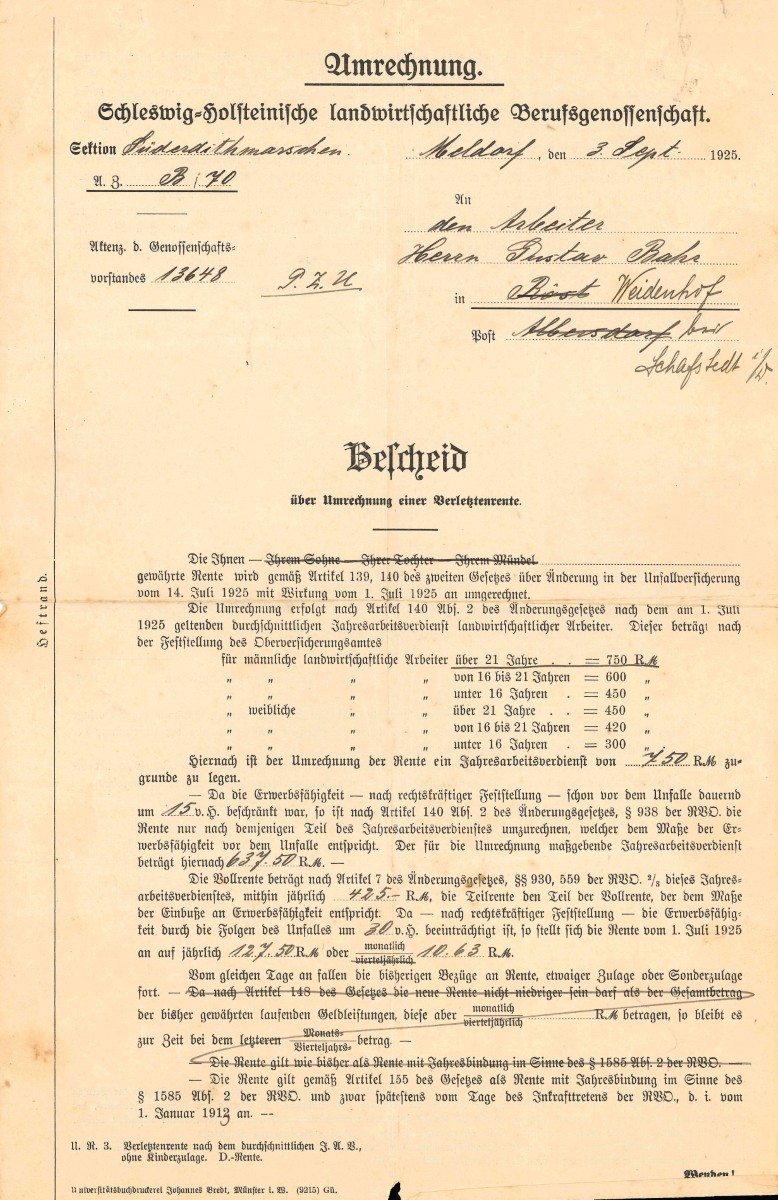
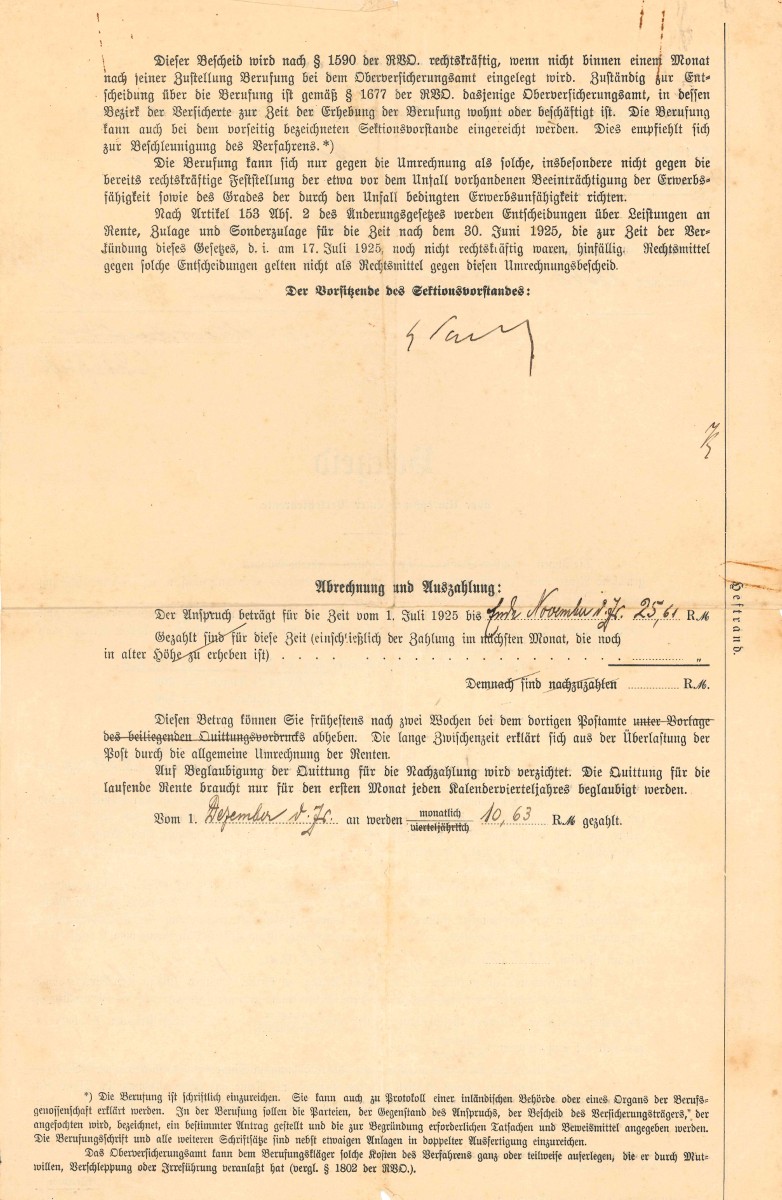
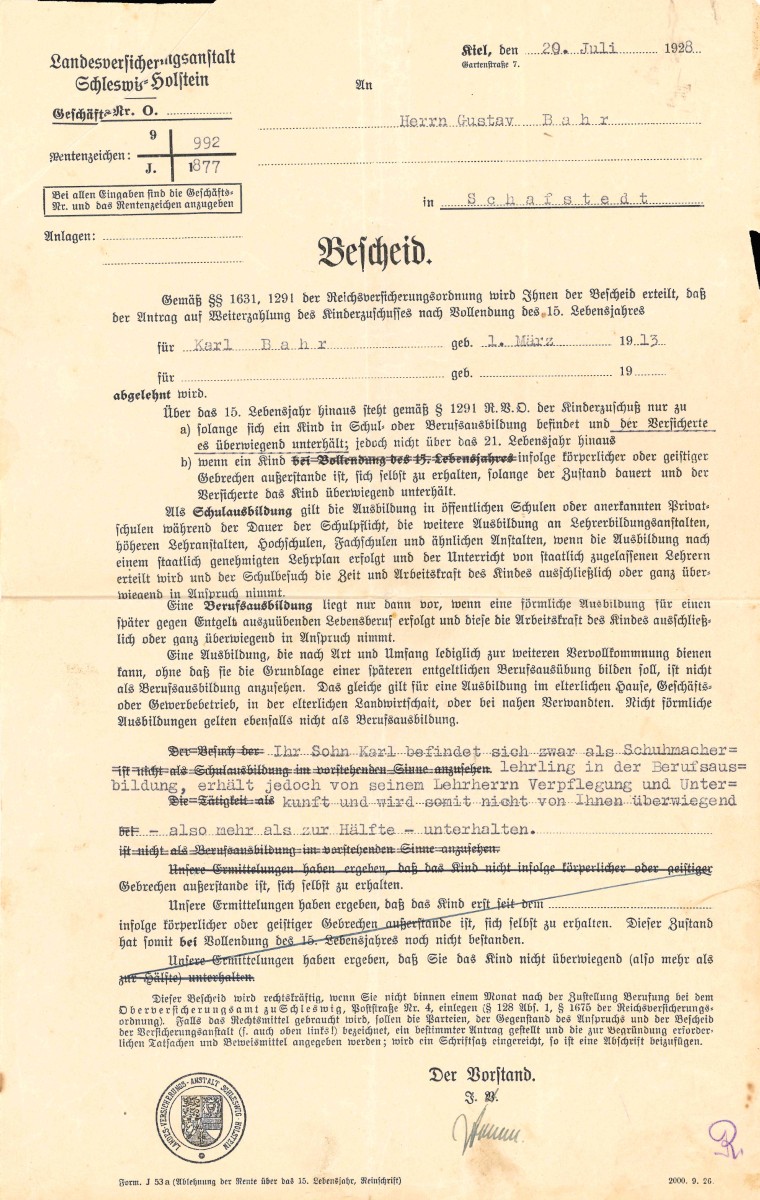
This is a fascinating set of documents, not a single postcard but what appears to be a coherent personal case file documenting one family's decade-long dealings with the German social insurance bureaucracy, from 1925 to 1935. The thread connects through "Gustav Bahr," an agricultural worker (Arbeiter) in Weidenhof/Schafstedt, Dithmarschen (Schleswig-Holstein).
1925: the accident pension (Verletztenrente): The earliest documents come from the Schleswig-Holsteinische landwirtschaftliche Berufsgenossenschaft, the regional agricultural workers' accident-insurance association (a Berufsgenossenschaft was Germany's trade-specific mutual insurance body for workplace accidents, dating back to Bismarck's 1880s social insurance laws). A "Bescheid über Umrechnung einer Verletztenrente" from the Meldorf section (3rd Sep 1925) recalculates Gustav Bahr's accident pension following a legal amendment of 14th Jul 1925. It documents that he had a permanent 30% reduction in earning capacity from an earlier workplace accident, bases the recalculation on an assumed annual wage of 750 RM for male agricultural workers over 21, and sets his pension at 127.50 RM/year (10.63 RM/month) retroactive to 1st Jul 1925.
The companion notice from Kiel (8th Oct 1925) instructs the post office to pay him accordingly, a lump sum of 25.61 RM for Jul - Nov 1925, then 10.63 RM monthly going forward. This illustrates the routine administrative machinery of the Weimar-era workers' compensation system.
1928: a dispute over child support supplement: Three years later, a different but related agency, the Landesversicherungsanstalt Schleswig-Holstein in Kiel, rejects (29th Jul 1928) Bahr's request to continue receiving a Kinderzuschuss (child supplement) for his son Karl (born 1st Mar 1913) past age 15. The law allowed the supplement past 15 only if the child was still in school or vocational training and "predominantly" supported by the parent. The agency's reasoning: Karl, now in a shoemaking apprenticeship, received board and lodging from his master craftsman, so he wasn't predominantly supported by his father.
Bahr's handwritten appeal (Berufung), sent from Schafstedt on 6th Aug 1928, pushes back: Karl had first tried a gardening apprenticeship but had to quit for physical reasons, then switched to shoemaking; Bahr says he had to outfit his son for both trades and buy all his tools, and still covers clothing and other needs beyond room and board, arguing this still amounts to "predominant" support, and asking the supplement continue through the end of the apprenticeship. This is a small but vivid window into how working-class families had to fight bureaucratically, almost line by line, for modest social benefits.
1935: a letter to the widow(?). The envelope (not the contents) from the same Landesversicherungsanstalt Schleswig-Holstein, postmarked Kiel, 19th Sep 1935, addressed to "Frau Emma Bahr geb. Widderich" in Schafstedt is the latest item in the set..
The shift from "Herrn Gustav Bahr" to "Frau Emma Bahr" strongly suggests Gustav had died by this point and the correspondence had shifted to his widow, likely regarding a survivor's pension (Witwenrente), a typical continuation of these accident-insurance case files.
Taken together, this is a glimpse into ordinary working-class life under German social insurance bureaucracy across the Weimar Republic into the early Nazi period, accident compensation, child benefits, and eventually widow's benefits, all mediated through dense legal citations (RVO articles, Rentenzeichen file numbers) but ultimately about a farm laborer's family trying to make ends meet after a workplace injury.
REFERENCES
1. "DIE DEUTSCHEN POST- UND ABSENDER-FREISTEMPEL" - Handbuch und Katalog by Heiner Dürst and Gerd Eich. Heft Nr. 90
2. "Die Deutschen Post- und Absenderfreistempel Band 1" - Die Absenderfreistempel des Deutschen Reiches und ihre Aptierungen Handbuch und Katalog by Heiner Dürst and Gerd Eich.
3. Wikipedia International Postage Meter Stamp Catalog Germany Page 1
